This era in history may be remembered as the "Peak Age", a brief time when nearly all materials used to power and create our society reach the maximum extraction and production potential. Past this point, all of these resources become increasingly difficult to extract until they are no longer economically viable resources to be using. There are hundreds of examples of resources, currently embedded in our industrial society, which have reached their peak in the 50 years surrounding 2010, but the one which will most impact our society is petroleum.

The goal of living for 100 days without oil is to understand the extent of our dependance on oil in American society today. Specifically, how it will affect my life, as a 25 year-oil living in Minneapolis, MN. By using myself as a metric I can take a close and conscious look at where oil dependance occurs in all aspects of our daily lives : How we transport ourselves from one place to another, what we eat, how much waste we create, how water is cleaned and transported, where oil is used as; an energy resource, in conventional medicine and for hygiene and how oil affects how we entertain ourselves and communicate with others. By demonstrating how someone would be forced to live without using any oil resources, outlining both what the sacrifices will be as well as the benefits, we can can identify the many systems which will have to be re-designed in a world without cheap oil, and explore a new way of living in which we live in an energy balance.


(At the bottom of this page is a link to my version of a flow diagram of 'Where Petroleum Exists in Our Daily Lives' (using information from the Energy Information Administration-Annual Energy Review 2008 fig 5.0 Petroleum flow) click and zoom to enlarge)


Thursday, April 26, 2012

threeACTIONS Project

A lot has happened since last posting here.

Since March 2011, I have been working in collaboration with public policy graduate student Megan Hoye, on a project we have titled the threeACTIONS Project.   

The project explores how combining many individuals’ understandings and personal experiences can affect how design solutions are realized at a larger infrastructure and policy scale. Participants will choose three actions from a list of 50 which they are personally interested in exploring, and they will commit to these sustainable actions in their lives for a period of three months. 

They are grouped into cohorts of people who chose similar actions, creating small groups who can share and track each other’s experiences and providing support and incentive to continue. In addition, experts on topics of water, waste reduction, energy use, local foods and transportation systems will be brought in to further inform and encourage participants.  
 
The goals of this project are threefold.

First, to connect participants to information and experts which can help grow their knowledge of sustainability issues.

Second, to help individuals experience new lifestyle habits that challenge their norms and assumptions about sustainable living, while expanding their openness to future change. 

Third, to use this body of shared experience to inform policy and infrastructure level change to make efficient and sustainable choices the easier, less expensive and more enjoyable choices. 

There is no invaluable experience. If a chosen action is found to be impossible based on a person’s current living situation, it is important to document their struggles. In the same way, people who are successful with their actions provide valuable information about their successes. We want to provide individuals with a supportive community of diverse participants with whom they can build shared values about issues relevant to their experiences during and after the project.  

This kind of approach allows design to expand upon the making of sustainable environments, going beyond building performance. 

There is an attitude that sustainable design must fit within the parameters of the kind of lifestyles we are used to living instead of allowing the buildings themselves to empower and teach inhabitants to live in more sustainable ways. This approach leads to solutions such as low-flow water fixtures which allow inhabitants to use less water, but they don’t create a need for people to have any understanding of these systems. While building performance and material construction are crucially important pieces of creating sustainable living environments, our work as architects should not end there. 

The pilot program of the threeACTIONS Project will begin in June 2012 and can be followed through our facebook and twitter pages as well as our website:

threeactionsproject.org

If you are in the Minneapolis, MN area and are interested in being a participant in the project, apply on our website!


This post is likely to be the final post on this blog as my focus changes from the individual experience of my project to bringing these issues to my local community.  Thank you to all the anonymous readers who have all had a supporting hand in the creation of both of these endeavors!

Cheers,
Molly

Wednesday, April 13, 2011

MN MONTHLY

13 April, 2011

The May issue of Minnesota Monthly just came out and has a 2-page article featuring my project!  Thanks to Ellen Burkhardt for a well-done summary of my experience and the metrics that go along with it:


(click to enlarge)

Now for an update on my current efforts.  As I mentioned before, I've spent that last few months compiling my '100 days' experience into a 170 page document which is a much more complete description and analysis of the facts behind the issues I explored here as well as a series of design considerations presented as hypothetical solutions to many of the things I struggled with during the project.  Because the project was essentially exploring what systems exist in our current society to support a world post-cheap-oil, many of these design solutions focus on the urban form, while the others focus on the scale of our homes. 

I'm working on exploring publishing options at this point.  My desire is to make this information as available as possible to anyone who might be interested in exploring changed actions in their lives similar to those I explored.  The publication will be titled '100 Days Without Oil: Lessons learned from attempting to live in a resource balance.'  Please check back for more information about this soon!

On another front, I have been collaborating with a public policy student at the University of Minnesota to brainstorm how we can continue the work I began with this project at a larger, community scale.  While we are still generating ideas for how to carry this forward, our goals are to attack this problem from its two ends- both from the bottom up (as my project was) and from the top down (in environmental policy changes).  I'll continue to update on our efforts here!

Wednesday, March 23, 2011

DAY 100_THE END?

November 22, 2010

Day 100

Day 100

Day 100.  I know it's been a long time coming to post this and I apologize to many of you who have supported this project by reading my daily posts for leaving you all hanging for so long! 

I DID, in fact, finish this project.  And I would like to share my experience of the end of the project, the day after and my reflections and the conclusions I have come to in the months since I finished in November in this and the following posts.

Writing this post retrospectively, of course I am having to rely on the notes taken from that day:

Waking up to the last day of this project, it does not feel quite as spectacular as I had envisioned it.  However, thinking back to the 99 previous days of changing my lifestyle in an effort to come as close to living in a resource balance I realize just how drastically my views of lifestyle choices have changed. These changes have become habit and only in the context of looking back to the way I used to view things can I truly appreciate the extent of change in my life. 

The best example of my changed awareness is in my food shopping habits.  Before the project was even an idea in my mind, my regular grocery habits included shopping at a chain grocer which was is 7 blocks away from me.  While I would sometimes walk there, more often I drove.  I shopped at the co-op only 2 blocks away from my house only rarely.  It wasn't important to me to buy organic foods, and though I was aware of the issues of food transportation I never made a point to buy locally.  When buying produce, I used the plastic bags provided for me.  I would bag up a couple of tomatoes or a head of lettuce.  Looking back I think I simply had never been exposed to another way of shopping for food.  Years of watching my mom bag up produce made me think this was just how it was done. I never thought twice about it.

Thinking about the many decisions I made about buying food now after doing this project I am amazed by how many of the decisions I made were made simply out of habit.  It took my conscious effort thinking about the impacts of each decision to realize that there was, in fact, another way of doing things.  This isn't brain science it is simply awareness.  I now shop almost exclusively at the co-op.  Not only is it closer, but I have a deep appreciations for their efforts in providing local and organic food.  Anything that I can buy in bulk I choose to do over packaged goods.  I've realized that it is not only fresher food, but is saving me money to shop this way.  I never bag any produce in plastic, there is no need for most vegetables and I use reusable cloth bags for anything such as bread that needs to be protected. 

I look back on all the categories of the project in the same way in which I do with food. I realized that I could bike and walk to many places I shop, run errands and do work every day.  It wasn't that I was opposed to walking before, it just simply didn't cross my mind.  I became aware of how much waste can be diverted from landfills by buying food in bulk and ate fresher and saved money in the process.  I became aware of different ways of using water and energy as well. 

The realizations of how drastically different I now view most of the actions of my lifestyle is not surprising to me knowing that I spent 100 days making a conscious effort to take a close look at my life.  In most cases, these changed habits were not a sacrifice but simply a changed awareness and acknowledgment of learning to do things in a different way.

In this way, I spent today like any other day in the project, but thought quite a bit about what had changed in my life, why it had changed and whether many of my new habits were here to stay...


Tuesday, January 4, 2011

DAY 99_SUMMARY: HEATING + COOLING

21 November, 2010
Heating costs proved to be by-far the largest energy user in my house.  Although my house has natural gas-heated radiators, by converting Therms to kWh, I could compare the energy used for space heating to the energy used for all other electric uses.  Space heating requires an average of 704 kWh/week, whereas my fridge uses 3.8 (previously 11.6) kWh/week and I use about 1.6 kWh/week (previously 12.6)  for all lights.  Water heating came in as the second highest energy user at 11.2 kWh to heat only 15 gallons per day (41.5 kWh/week before the project). 

This presents a big challenge because unlike many of the other electrical uses which can be minimized or even eliminated, space heating in a climate like Minneapolis is a necessity.  When I discovered what a huge energy user space heating is, (and that it couldn't possibly fit in my 3 kWh/day budget) I couldn't help feeling like all of the rest of the electricity savings I had been changing had been somewhat in vain.  While there are sustainable solutions to this problem, they, unfortunately, aren't ones which can be easily retrofitted to homes.  Passive solar houses are a great solution and proven to work in northern climates, capturing the heat from the sun in thermally massive elements in the house and slowly venting the heat into the living space.  However, in dense metropolitan areas this is a challenge as not all homes have access to solar exposure. 

So many of the changes I made during this project got more difficult as the weather turned colder, local foods disappearing, harder to get around by bike..., but space heating may be one of the biggest challenges for designers in cold climates as fossil fuel energy becomes increasing scarce and expensive. 


DAY 98_ SUMMARY: WASTE

November 20, 2010

I feel that trash may be one of the easier ways to make big impacts with small (but consistent) changes to our lifestyles.  In my experiment, I managed to; eliminate organic waste with worm composting, dramatically reduce food packaging waste by buying in bulk, and focused on reducing ALL waste, not just waste which cannot be recycled.
Starting a compost bin was quite an adventure having never grown up composting and being totally unfamiliar with it.  I started composting without worms.  I built a bin made of two rubber tubs which stack inside of each other.  One is slightly shorter than the other and has holes drilled into it so any liquids drain into the lower bin to reduce sludge buildup.  However, after a few weeks of 'composting' I had attracted a lot of bugs in my bin and the food was molding and rotting.  Consulting with a friend who is a composting veteran, I realized that it is easier to start with some organic matter (dirt) already in the bin and that ventilation is crucial without worms.  By this point, my bin was full of maggots (yeah gross) and we decided it was best to start over and do it the right way.  My friend brought me some worms from his bin and I started with a little dirt, food scraps, my new worms, and some damp newspaper for bedding.  Once I had enough accumulated compost I could stop adding newspaper and the worms have done the rest of the work for me for 4 months now.  Some of the common misperceptions about composting are:
Common Misperception #1- It doesn't matter if you compost because organics will just decompose in the landfill. 
I thought this for a long time until I learned that decomposition can only happen in environments with oxygen.  Since landfills are so tightly packed with matter, they become anaerobic environments, turning any organic matter into sludge at best (or simply not decomposing at all).  Because of this, that banana peel you are throwing away might as well be a milk jug because it isn't going anywhere. 
Common Misperception #2- Compost will accumulate and I have no where to put it!
Worm composting is somewhat magical, in that the worms seem to moderate their population to eat as much waste as you throw in the bin.  More food=more worms, less food=less worms, and after 4 months, my compost is at the same level it was at month 1.  The compost becomes a dense, nutrient-rich mixture which is perfect organic fertilizer for indoor plants or to use in a backyard garden in the spring.  However, accumulation has proven not to be a problem. 
The second big change to reduce waste is getting in the habit of buying in bulk.  Luckily, I live 2 blocks away from one of the most awesome coops in Minneapolis-The Wedge, where there is a huge focus on stocking local bulk foods.  For over 3 months I was able to buy only local food and make no packaging waste by; buying milk in reusable containers, bringing my own egg trays, and using mason jars to fill up with bulk foods, spices and oils.  The only exception was cheese (which in the future could be packaged with compostable wrap).  I found local breweries within biking distance which sold refillable growlers for beer or only bought drinks on tap, no bottles.  I changed eating habits and learned to cook with what I could find in bulk when options get more limited.  In the process, I learned to cook from scratch many recipes which I would normally just have bought pre-made: tortillas, fresh rolled pasta, crackers, bread, pasta sauces, pesto, scones...the list goes on.  I eliminated countless preservatives and food additives from my diet which normally come in package foods. According to one of the managers of the Wedge, most of the food in bulk is much fresher than packaged foods as it is allowed to bypass a few steps of the shipping and storage process.  Lastly, I saved money.  Anytime you are buying any pre-packaged food you are also buying the container.  A link to a blog post on this is found here: http://100dayswithoutoil.blogspot.com/2010/10/day-71your-also-buying-container.html
Lastly, I focused on reducing ALL waste, not just waste which cannot be composted or recycled.  Although recycling is certainly better than simply throwing items into a landfill, there is still a significant amount of energy involved with transporting this waste.  Recycling trucks (as well as garbage trucks) get around 3.2 miles per gallon, so a trip to even a nearby recycling center contributes significant carbon emissions and fossil fuel depletion.  The better option is to find ways to eliminate this waste in the first place, only using what you absolutely cannot avoid.  While there are not yet many alternative options for household items, food packaging has come a long way and ends up being the majority of our packaging waste anyway.
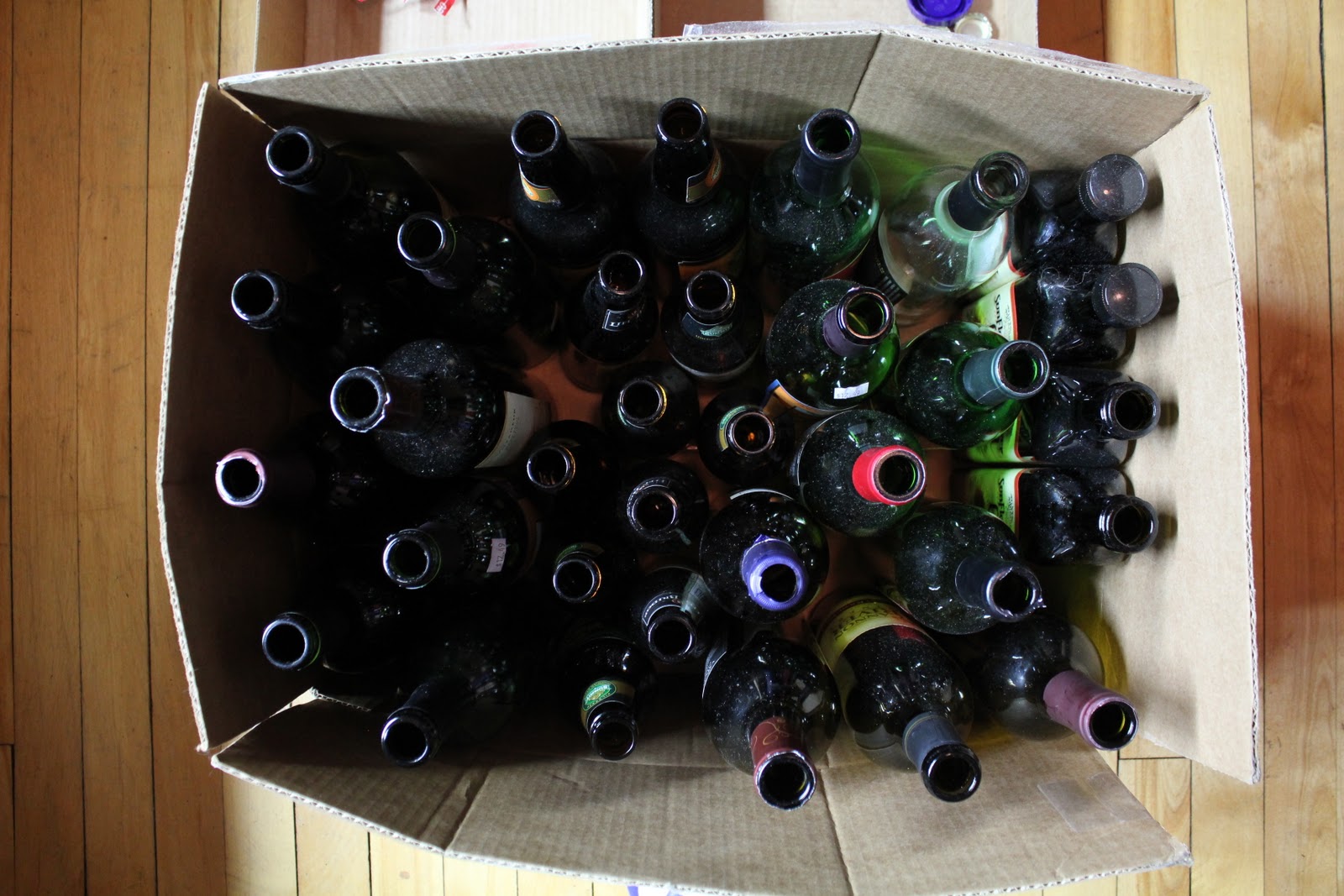
I collected all waste for the project and ended up with a box of glass bottles and another box of paper products, milk pull tabs, caps for jars and bottles, twist-ties and some plastic packaging.  I ended up with half a paper bag full of material which could not be recycled, and about 3 paper bags full of recycled material. 
100 days of trash

twist-ties from greens, milk sealers, assorted caps and a few plastic tubs

recyclable paper products and carboard packaging

bag of actual trash, which cannot be recycled, mostly plastic packaging

glass bottles, sunflower oil

In the end, while I have not figured out how to eliminate ALL waste, a major dent has been put in this impact by adopting different food-buying habits and feeding my worms!

Monday, January 3, 2011

NO IMPACT WEEK DAY 1

Hello Everyone,

I promise I'll finish writing the last 3 posts of my blog ASAP, however, in the mean time check out what I'm blogging for 'No Impact Week'.  Yes! Magazine has asked me to participate in Colin Beaven's (of No Impact Man movie) week-long experiment in living with less impact.  I think it will be an interesting way to revisit my project after a month of living back in the real world, and hopefully permanently get back into some habits that I've lost touch with. 

Here is a link to the first blog post, Day 1-Consumption:
http://www.yesmagazine.org/planet/molly-blogs-on-no-impact-week

Molly

Wednesday, December 1, 2010

DAY 97_SUMMARY: ELECTRICITY

19 November 2010

In a post cheap oil world we will be at a loss for many forms of energy we currently depend on, primarily transportation fuels.  However, electricity in the form of renewable energy will still be plentiful, it is just a matter of capturing it.  Being in a city, wind energy isn't a first choice option In one of my first posts I calculated how much solar energy could be captured utilizing my entire roof.  I disregarded cost of the panels in this scenario assuming that without oil or coal electricity, people would be more willing to maximize their systems regardless of cost.  However, I choose a middle-of-the-road panel efficiency of 8 watts/sq ft (I've seen up to 16w/sq ft).  Dividing the total solar roof array by 6 people I came up with a personal electricity budget of 6.82 kWh per person per day.  This number seemed pretty high, however, and would actually cover our current electricity use according to our bills.  Because of this and to take into account less efficient panels which are more reasonably priced currently I cut this number in half to come up with an electric budget of 3.4 kWh per day. 
Similarly to my water calculations, I then measured all of my daily electricity use with a Kill-A-Watt Meter to come up with metrics. 

I found that I use about 6.7 kWh per day.  Unlike water use, however, the small-wattage devices such as light bulbs really add up because they tend to be the ones which are on for the most hours of the day.   Regardless, it is still interesting to experiment with alternative ways of accomplishing tasks without electricity.  Before the project I calculated that I typically have about 6-7 light bulbs on at any given time the hours that it is dark outside.  I reduced this use to making sure I only had two light bulbs on at a time.  One of the things I tried to supplement this light was making my own candles-out of soy wax because regular wax is a petroleum product.  I used only candles for light for a few weeks but found that I needed at least one light bulb on for reading. 


I researched how much energy was involved with various methods of cooking: toaster oven , electric oven, stove burner and microwave.  I found that microwaving is about equal to the energy use of an electric stove top burner.  An electric oven is about twice this energy.  On Day 24 I blogged about the rise of electric use in homes throughout the last 50 years.  With more and more appliances using electricity instead of manually operating, the small uses end up added up to a lot. 

I eliminated some uses of electricity entirely including; hair dryers, use of the oven, cut light bulb use 75%.  I began using a mini fridge instead of the large one and saved 2/3rds of the energy for refrigeration.  There were added uses of electricity during the project as well.  I started using a high-intensity fluorescent grow light to grow food indoors and had to make up for this use with my other electricity savings. 


Below is a chart of before and after electricity use:


Lastly, I explored the use of solar power by visiting the PassiveHaus in the Woods as well as volunteering with the Minnesota Renewable Energy Society at their state fair exhibits.  I tried out my own application of solar power on a small scale by building a solar-powered stereo which mounts on my bike.  These experiences gave me an understanding of the potential of solar power, but also how far we have to go to meet our current energy needs. 


Tuesday, November 30, 2010

DAY 96_SUMMARY: WATER

18 November 2010

Water proved to be one of the easier tasks to accomplish during the project.  With my water budget at 15 gallons a day (calculated from average rainfall amounts and divided into # of residents in my house), I was able to stay within this water range fairly easily for the ffirst two months of the 100 days (August 15-Oct 15). 

By tracking all water use and measuring the flow rates of all water fixtures I was able to identify what daily uses were big water users and target those for saving water.  I calculated that before the project I used 54.4 gallons of water a day, and there were three primary suspects for this water over-use: showering (20 gallons), laundry (6 gallons) and toilet flushing (10 gallons).  All of the other uses (except dish washing) of water were under 1 gallon per day which didn't leave much room for changing habits.  Therefore, by focusing on how to decrease my water use for showering, laundry and toilet flushing alone I could significantly decrease my water use.

For showering, I took 1 gallon bucket showers.  I used a bucket and sponge standing in the bath tub and found that this was more than enough water to wash up every morning without washing my hair.  With pretty dry hair I could pretty easily get away with only washing it once a week, so Sunday's became the big 'wash day'.  Once a week I would heat 5 gallons of water using a solar camp bag and take a longer bucket shower to wash my hair.  I realized when changing my showering habits that taking a long morning shower was more of a ritual than serving a real important purpose.  Rinsing off with significantly less water did the trick just as well and saved 95% of the water. 

I changed my laundry habits from using 42 gallons/load in the washing machine to only about 12 in a 5 gallon bucket hand washing.  Hand washing allowed me to use about 1/2 the detergent I normally use as well.  My method was to fill the 5 gallon bucket with clothes and detergent, let it soak and then use my feet to stomp it.  I was surprised to see how dirty the water got even when my clothes didn't seem that dirty.  After the water was pretty dirty I would dump and refill the bucket with 2-3 gallons of water and squeeze and shake the clothes by hand to get the rest of the detergent out.  Lastly, I rinsed with another 3 gallons of water and hung clothes to dry in the bathtub.  Less convenient than throwing clothes in the washing machine? yes. But it was sort of a stress reliever and satisfying to actually see my clothes getting clean and knowing it was only using my energy. 

Lastly, toilet flushing uses 2.6 gallons of water per flush.  I cut this use by a gallon by putting a milk carton filed with water in my tank to lower the water level for each flush.  I estimated that before the project I flush about 5 times a day.  To cut down I fell back on an old saying, "If its yellow, let it mellow..." which went over fairly well with my roommates (they are doing it now too).  These changes reduced my toilet flushing water from 10 gallons down to only 3.2 (two flushes per day). 

However, as the weather changed, so did my priorities concerning water use.  While it was easy to shower with 1 gallon of water in warmer weather, I found myself spending the whole day cold after a cold morning rinsing.  I changed my showering habits to taking 3 minute showers twice a week.  I installed a cheap flow shut-off valve on the shower head which allowed me to turn off the water when I wasn't rinsing (and not have to run water again to get the right temperature back).  I also found that in cooler weather as I began preserving foods with less fresh produce available, I needed less water to rinse vegetables. 


Monday, November 29, 2010

DAY 95_SUMMARY: TRANSPORTATION

17 November 2010


45% (19.15 gallons) of every barrel of oil (42 gallons) is gasoline.  This means that the petroleum created to run our cars is by far the largest single use in each barrel extracted from the earth.  While transportation isn't the biggest total energy user in our daily lives, it IS the biggest petroleum user. 

While I biked quite a bit before this project started, it makes a big difference to be riding every time you want to get around.  Without using cars and buses as back up transportation for cold or wet days, bicycle commuting takes on an entirely different face.  I think a lot harder about whether I really NEED to go somewhere, ended up staying home many days that I didn't have classes instead of going somewhere to work.  I started to modify my schedule so that I could ride around with other bikers and didn't have to bike alone (especially at night).  Unlike driving, the routes taken depend on the weather and the time of day.  While bike paths in Minneapolis are best during the day and during rush hours, well-lit main streets were a better option for late night rides home (even with traffic).  As soon as it gets snowy and icy, I had to factor in another 10 minutes of riding time.  Bicycle commuting changed the way I dressed.  While it is easy to bring a change of clothes, I was often only going somewhere for a few hours and it didn't seem worth it to carry.  Consequently, I pretty much wore the same few things for at least 2 months once the temperature started cooling off. 

Workout? Kind of.  There is so much starting and stopping that it isn't really much of a workout compared to the 30 minutes I would have spent on a treadmill.  Yes, obviously its better than sitting in a car and still is nice to get out and be outside for an hour or two a day.  I felt much more connected to the changing of seasons and it was really nice to watch the sun rise every morning while biking down the greenway. 

My conclusion: Biking is absolutely the best way to get around while the weather is good (or even decent).  For those brave and bad ass enough to keep going as the temp drops under 20 and the ground is covered in ice (as 1/3 of Minneapolis bikers do), I admire you, but would rather get on a bus December through mid March. 

Below is a graphic of the miles I biked each day for 100 days:  There starts to become a pretty clear pattern at the end of project when it starts getting colder I only bike to campus and back on days that I need to, whereas in the beginning of the project I was much more willing to run errands and take longer trips around the city. 


I biked a total of 1,150 miles in 100 days.  An average of 82 miles per week and 11.7 miles per day. 

My car gets 34 miles per gallons.  This means that if I would have driven this 1,150 miles I would have used 33.82 gallons of gasoline (about 3 trips to the gas station for me).  I didn't travel as much as I would have had I been driving.  Just to estimate what I may have used. I used to fill up my tank about every 3 weeks, so 4.6 fill ups of 12 gallons of gas would have been 56 gallons of gasoline.

Sunday, November 28, 2010

DAY 94_SUMMARY: FOOD

16 November 2010

For the last few posts I would like to think back and summarize how my life has changed during this project and what I have learned...

I'll begin with what was both the most difficult part of this project, and the most enjoyable- food. 

Looking back, having started the project in the middle of August it should have been REALLY easy to find local foods.  The middle of August in Minnesota is just about the peak of local food production, almost all vegetables can be found locally grown.  However, despite this plentiful bounty of local produce it was really difficult to get a handle on what things I could prepare with it using other ingredients (cheese, flour, oils, dairy....).  It took a while to seek out and find local milk, local flours in bulk, local butter in a compostable wrapping.  I compromised on the cheese, because although there are many local cheeses available they are all wrapped in plastic.  This became the only item I bought in packaging. 

After the first few weeks of the project I had figured out where to get most of the ingredients I needed for cooking locally and without packaging.  Many of the things I had a habit of cooking with however; olive oil, rice, avocados, soy sauce and many spices were no longer available.  I had to learn to cook many dishes that normally I wouldn't have prepared for myself.  Potatoes with mixed vegetables became a staple.  I learned to cook all bread products from scratch- loaves of bread each week, muffins, tortillas, crackers.  Made a lot of homemade pasta sauces and tried pizzas of all different kinds.  Below is a summary of many of the foods I made out of local ingredients during 100 days:


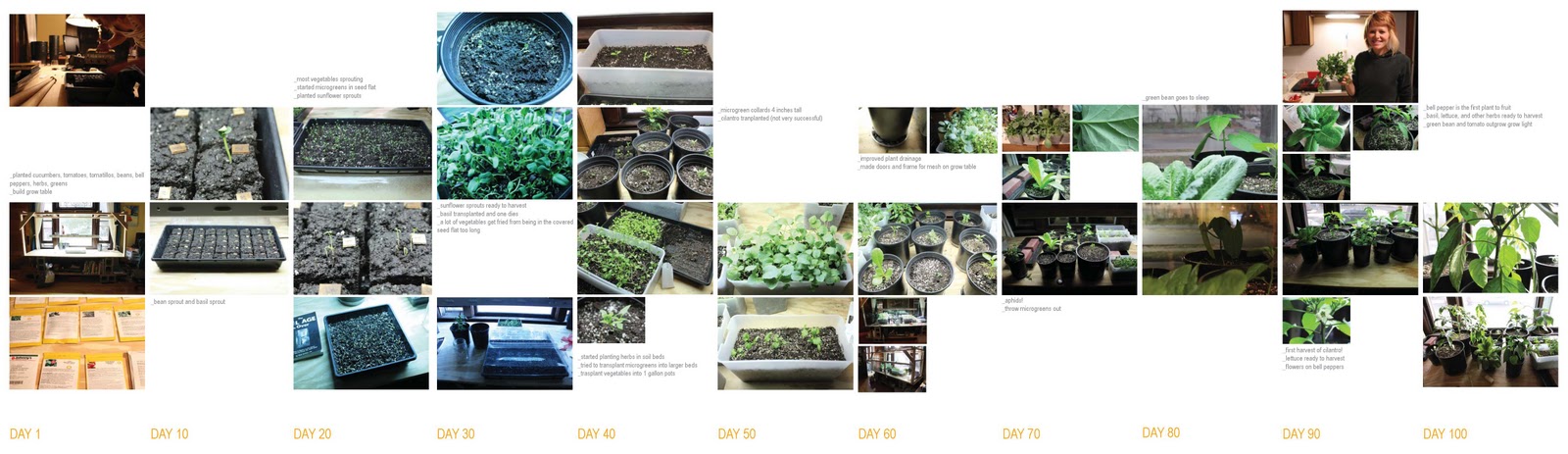
I had the idea to begin growing my own food indoors to have a food source after the growing season started to die down.  On day 1 of the project I planted a variety of of vegetables: tomatoes, bell peppers, cucumber, beans, onions, greens, and herbs to see what would grow with the available artificial light I had.  Having never grown a vegetable in my life I learned about gardening by watching my little sprouts slowly start to become recognizable vegetables.  I made plenty of mistakes growing the first few batches of seedlings and the grow table has gone through a few evolutions of goals.  My first idea was to have a variety of vegetables and keep whatever grew the best (not knowing if anything would have enough light to fruit).  After accidentally scalding the majority of my first seedlings (I left the plastic seed flat cover on too long), I began to reevaluated what kinds of plants would be most practical to my situation.  Because most vegetables are able to be stored (whether dried, frozen or canned), I decided to focus on growing what couldn't be stored very well-greens.  I started to grow a lot of microgreens which grow quickly and can be harvested after only about a month.  This was going fairly well until I was infested with aphids. My continuing battle with aphids was one I didn't know I was going to have to have with indoor plants.  While it was easy to pick the aphids off of most of the single plants, they were almost impossible to get rid of on the densely planted microgreens.  I ended up having to get rid of a lot of the greens and went back to focusing on growing some vegetables. 

Around day 85 I got my first flowers on vegetables and realized that without insects and wind to pollinate plants I would have to play the role that nature usually does.  After 90 days I finally have my first fruiting plants with a little bell pepper growing!  This is really exciting because I was starting to doubt that any vegetables would have enough light to produce fruit. 

My new plan for the grow table is to make a habit of planting a few new vegetables every month, so I can have a continuous supply of at least some fresh produce.  Below is a timeline of the grow table over 100 days:

click to enlarge

Lastly, it was interesting to explore restaurants that advertised themselves as local food focused.  I found that there were many exceptions to their 'localness'.  While 'local' dishes are offered year-round, they are only truly local when the food is in season.  Many restaurants I ate at didn't offer many ( or any) local wine/beer, and all used olive oil instead of sunflower oil. 

I learned to can, dehydrate and blanch vegetables for preservation, and tested how long I could store potatoes, onions and garlic.  I ate only preserved foods for the last month and found that it would be really difficult to eat nothing 'fresh' for the 8 months of the year that fresh local produce is not available. 

Tuesday, November 23, 2010

DAY 93_DO SWEAT THE SMALL STUFF (ELECTRIC COUNTS)

15 November 2010

One of the interesting realizations I've had during this project is that we need to have different our attitudes about the various resources we use depending on our habits of use. 

I blogged earlier about identifying the big water users in your lifestyle and working to reduce them as the most effective way to reduce water use (and live within our water budgets "Don't sweat the small stuff-Water use" (http://100dayswithoutoil.blogspot.com/2010/10/day-60dont-sweat-small-stuff-water-use.html).  Electricity, however, seems to have the opposite story to tell.  While there are some very high-wattage appliances I use regularly, they are often the ones that only get used for a brief amount of time, so they don't end up being the main energy users.  On the other side, many of the seemingly small energy users (a single light bulb of only 60 watts, or even the fridge at 68 watts /hour) end up being big energy users because they are used almost all day.  The small stuff adds up, wattages need to be taken into account but the time-of-use is critical in electricity counts.

The following pie charts show a comparison of watts per hour of energy users vs watts per day:


 As you can see, the appliances with the highest  watts per hour (hair dryer, toaster oven, microwave) are very different from the appliances that actually contribute to most energy use as seen in the watts/day pie chart.  The biggest energy users when taking time of use into account end up being light bulbs (we have about 6 60 watt bulbs on most of the time), the refrigerator and the grow light.  Each of these energy users are have fairly small wattages compared to some appliances, but add up to a lot throughout a day of use.

This chart shows the two values next to each other- Watts per hour vs Watts per day.  The three biggest energy users are in the dashed boxes, notice how small the wattages/hr are compared to some other appliances that don't end up adding up to much!

Monday, November 22, 2010

DAY 92_HAND POLLINATION

14 November 2010

I'm finally getting flowers on my bell peppers and jalapeno plants!  Being that my plants are growing inside, however, means that there are no insects to pollinate the flowers into fruit-bearing plants.  This is a problem that greenhouses run into because of the lack of insects, as well as some small city gardens where the insect population isn't in full swing. 

There are two kinds of pollinating plants; " those that produce male and female blossoms, and those that only produce one type of flower. The former include plants such as zucchini and squash, cucumber, and watermelon. In the latter category are eggplant and bean. These are called "perfect", "bisexual" or "complete" flowers because everything is contained within each bloom. Hand-pollinating is not difficult for either type of plant, but the approach is different" http://vegetablematter.blogspot.com/2009/08/how-to-hand-pollinate-your-vegetables.html

The good news is pollination is fairly simple to simulate.  One of the easiest ways is to introduce ventilation fans which allow the pollen to circulate from flower to flower.  In the same way, shaking the plants which flower buds gently will allow pollen to fall.  If this doesn't work, however, you can pollinate by hand using a small paintbrush or q-tip. 

With plants that produce male and female blossoms, the females can be identified by a tiny vegetable bud growing at the base of the flower.  To pollinate this type of plant, snip a few of the male blossoms off of the stem, remove the petals, and shake pollen into the female flowers.  For plants whose buds have both male and female parts, I used a Q tip to transfer pollen from the male 'stigmas' onto the single female 'anther' in the center. 

My understanding is that the blossoms will close up when pollinated and begin to grow the fruit.  If the flowers are not closed up after a day or so, try pollinating them again. 

Good luck little peppers!

bell pepper flower

green bean flower

DAY 91_FOR THE LOVE OF OIL

Oil creates the illusion of a completely changed life,
life without work,
life for free. 

The concept of oil expresses perfectly the eternal human dream of wealth achieved through lucky accident.

In this sense, oil is a fairy tale and like every fairy tale,

a bit of a lie.


Ryszard Kapuscinski (quoted in Crude by Sonia Shah)

deepwater horizon 4.20.2010

DAY 90_NO IMPACT MAN EXPERIMENT

12 November 2010

One of the people to blame for me doing this project is Colin Beavan, writer of the book No Impact Man, and movie of the same name http://noimpactproject.org/movie/.  A writer in New York City, Colin drags his wife Michelle and baby girl along as he attempts to change their lifestyles to be as 'no impact' as possible for one year. 


In phases (an idea in retrospect that I would have copied), the Beavan family focus on changing the following aspects of their lives one at a time: Consumption, Trash, Transportation, Food, Energy, Water and Giving Back.

For one year, they don't buy anything new except food, eliminate trash as much as possible by composting and shopping at farmer's markets, get around only by bicycle and scooter, eat locally, turn off their electricity (including heat and refrigeration) and try to find ways to improve their environment both environmentally and socially. 

Sound familiar? Yeah, I saw the movie last summer when brainstorming ideas for my thesis project and was immediately brainwashed.  There are some really beautiful moments of their family becoming closer and learning about what they really need while doing the experiment that are captured in the movie.  What could be looked at as drudgery and sacrifice they find ways to use their situation to their advantage, kicking a TV habit, losing weight, spending more time together, and reducing their desire for material things.

Although I got a lot of my ideas of how to frame my project from watching the Beavan's experience, I thought it would be more relevant to give the project a scenario that would give me clear 'criteria' or 'rules'.  Although I focused initially on '100 days without oil', it has morphed into more of '100 days living within an energy, food and water balance'. 

YES! Magazine has asked me to participate in (and blog about) doing Colin's one-week No Impact Man Experiment http://noimpactproject.org/experiment/.  This is basically a one-week trial of what his family did for a year.  Each day is a focus on a new aspect of the project.  Hundreds of people across the country and world sign up to try the experiment which is held a couple times a year, and write about their experiences. 

While I have some criticisms No Impact Man after doing my own version, it will be interesting to compare our methods.  No Impact Man is an expereiment admittedly driven by guilt.  The subtitle of his book is: Adventures of a Guilty Liberal who attempts to Save the Plant and the Discoveries he makes about our Way of Life in the process.  While guilt is certainly a motivator for people, it isn't really a sustainable motivator.  I outlined the motivation for my experiment to be one of understanding how to survive in a post-cheap oil world.  By eliminating the 'guilt' or 'choice' factor, I am allowed to focus more on how we will make these changes, but have realized at the end of this project that it does all come down to our choices, and addressing that is extermely important. 

Colin's experiment seems to more vaguely define what 'no impact' is, allowing himself to pick and choose what aspects of his life me would like to change.  At the same time, they radically change some aspects of their life by not using any electricity.  Because we will never have NO energy, I feel that it is more relevant to play out a scenario of what may be happening in our futures.  Our projects are similar in that, neither one of us is trying to say that we WILL live this way at some point or even SHOULD live this way.  It is more of a test of our dependencies on systems that we were born into and didn't necessarily choose.  By taking many of the luxuries we have (because of energy resources of oil and coal) away for a while, we are allowed to see our attachment to them.

While his family goes back to their 'old' habits of living in some ways at the end of the project, they keep many of the changes and promote their experiment through their testimonials that their experience made them happier and healthier, gave them more time and saved them money. 

Needless to say, I haven't necessarily come to all the same conclusions. 

Starting Jan 3rd, however, I'll give No Impact Man a chance, for anyone who wants to join along, here is a link to the experiment: http://noimpactproject.org/experiment/

Wednesday, November 17, 2010

DAY 89_FOOD LOCATIONS

11 November 2010

The graphic below is part 1 of a comparison of where the food I have been eating before and during this project is coming from.   While all the food I am eating is labeled as 'local' below shows the locations of creameries, flour mills, farms, and orchards which have provided me with 'local' food throughout the 100 days.  (click to enlarge)


The co-op defines 'local' as any product which
  • can be delivered to the store within a day of travel or
  • is produced in Minnesota or the bordering states.
While the majority of my food is coming from within about a 75 mile radius, there are a few notable exceptions.  I was actually fairly surprised after mapping this out visually with mileage radius lines by how spread out many of the foods I am eating are.  A 75 mile radius of food is still a very different scenario than local foods being sourced from within the boundaries of a community or metropolitan area. 

Here is a brief breakdown of where each 'staple' food I have been eating is coming from:

FLOUR:
Whole Grain Milling
Located in Welcome, MN
120 miles away
http://www.wholegrainmilling.net/contact.html
PASTA:
Dakota Growers
Located in New Hope, MN and Carrington, ND
10 miles away
http://www.dakotagrowers.com/

MILK + HEAVY CREAM:
Cedar Summit Farm
Located in New Prague, MN
30 miles away
http://www.cedarsummit.com
GREENS, TOMATOES, PEPPERS, ZUCCHINI, ONIONS
Garden's of Eagan (Our co-op owns this organic farm)
Located in Farmington, MN
30 miles away
http://www.gardensofeagan.com/index.php
EGGS:
Harmony Organics
Located in Morristown, MN
50 miles away
http://www.harmonyorganics.org/5.html
BUTTER:
Hope Creamery
Hope, MN
70 miles away
http://www.wedge.coop/grocery/hope-creamery
APPLES, PLUMS:
Hoch Orchards
LaCrescent, MN
125 miles away
http://www.hochorchard.com/


SUNFLOWER OIL, POTATOES:
Driftless Organics
Soldier's Grove, WI
150 miles away
http://www.driftlessorganics.com/

CHEESE:
Hard cheese from Sartori Cheese
Located in Plymouth, WI
275 miles away

Slicing and Cheddar cheese from Widmer Cheese
Located in Theresa, WI
250 miles away

All of my food is coming from within a 300 miles radius.  While it's still better than the 1,500 mile radius that defines the average American dinner, it still isn't anything to be yelling about.  While my cheese and veggies aren't coming from California or Florida, they are still a stretch of the term 'local'.  However, any of these farms and businesses COULD be located around Minneapolis.  They aren't, simply because there still is not enough of a demand for it.  For most people, the motivation for buying local is to support local economies and eat fresher food. The scale of local foods operations cannot possibly compete with large-scale food production companies which distribute their products to stores all across the nation.  As out transportation fuel sources become increasingly expensive, however, the motivation could become more economically based. 

On the upside, I get to eat a buch of  super-tasty, local foods.  These businesses are often very small-scale, family run operations.  They take pride in the foods they are growing and making and you can tell by the taste.  It is interesting to go on the websites and read the stories of these businesses, they are often very transparent about their processes and growing methods. 

Some great websites on local foods in MN are here:

http://www.localfoods.umn.edu/
http://www.mnproject.org/
http://www.slowfoodmn.org/local.html
http://www3.mda.state.mn.us/mngrown/
http://www.mfma.org/

Tuesday, November 16, 2010

DAY 88_HOW LIVING WITHOUT OIL IS LIKE CAMPING

10 November 2010

6 reasons camping is like living no oil (and the lessons I learned from sleeping in the dirt)

  1_You shower less

Camping may be many people's only experience going a week or more without showering-it was mine before this project. With no easy access to water/showers and the fact that you are going to get all sweaty and grimy every day just after you get up, whats the point?  I  haven't necessarily felt smelly or dirty taking quick showers twice a week during this project.  The harder part was just ditching the habit.  I had a firmly established morning ritual and routine which was ingrained into my head since sometime around 7th grade probably which included getting all wet every morning and then drying off again.  Don't get me wrong, when it's shower day I'm ready and its time, but getting another 20 min of sleep every morning and saving energy not having to dry my hair  has been a change that I could get used to.


2_Cooking dinner is an event

Camp dinners are a big deal.  Everyone is hungry,  there is only one stove and usually only one person has the food.  This means everyone has to work together, spend some time making a good meal.  The way food brings people together camping is a lot like how  it has during this project. I've adopted the habit of cooking for at least a couple people probably 50% of the nights of a typical week.  After all, if you're going to go to all that work, might as well be worth it to more people than yourself. 


3_When the sun goes down, it gets dark

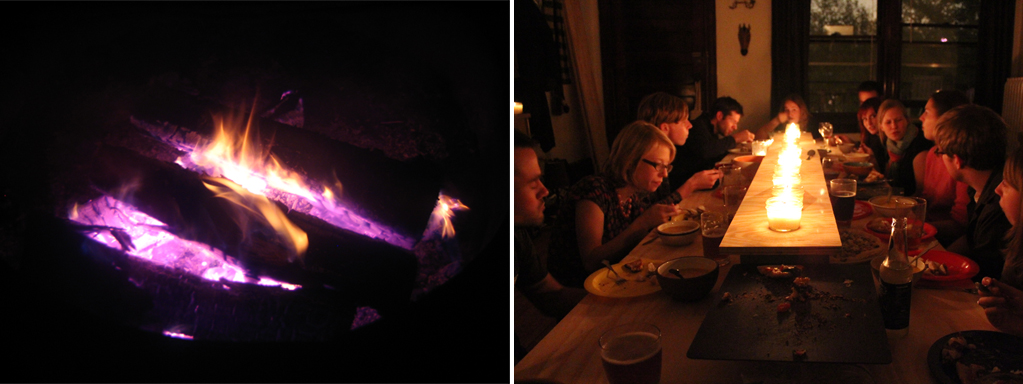
I mean, there aren't any other options.  Headlamps are the original task lighting.  The fire or lamp on a picnic table becomes the gathering place because it is the only place people can see (and its warm).  Its harder to move around when the whole area (or house) isn't lit up.  You walk to the bathroom, you gotta take a candle (or a flashlight).  Areas with the most lighting (like our table with a bunch of candles on it) automatically become the places people go to. 


4_Water is precious

Whether it is because you're waiting for it to rain or just haven't filtered enough water, water scarcity is a real issue in both camping and trying to live within your water 'budget'.  Camping in the frozen meadows below Grand Teton where the water is either frozen or ICE cold is a real test of how badly you need/want it and an excellent exercise in conservation.  Camping taught me how to do dishes in a no-oil world.  Use leftover boiling water from cooking for hot wash water. Pour your rinse water and wash water into two basins (or use the biggest two pots that are dirty).  Do cleanest dishes first. No running water needed.  Why do we abandon these habits when we go back to our homes with running water?


5_Connection with the elements

You havn't truly expereinced snow until you have slept in it.  And on it.  And under it.  I'm not trying to promote this in any way, it was actually kind of miserable, but gave me a totally different perspective of the kind of weather we have here.  We've done a great job at protecting and isolating ourselves from the elements.  After all, that's how we survived.  However, the more isolated we become, the greater the sense of unfamiliarity and even fear comes from being out in the elements.  Winter biking is a good example of this.  There aren't many mornings that I look out the window and get excited to jump on my bike and avoid snow chunks.  Once I am out there riding however, I realize how worked up I got about something that really isn't that bad.


7_You dress for the weather

Dressing comfortably and warmly for biking in freezing temperatures takes priority over looking nice.  These are my sisters on a winter camping trip in northern MN, clearly, the same deal ;)

6_Cannot create any waste

When we go camping we make NO waste, we EAT our toilet paper.  Well, maybe not.  Regardless, it is easy to be aware of how much waste you are creating when you are on a backpacking trip and have to carry it with you the rest of the trip.  Having to collect all the waste I create (even after eliminating as much waste as possible) has been a reality check for me (especially now that I have almost 90 days worth).  We've gotten really good at packing food and avoiding packaging in these situation.  There is also more motivation to avoid dumping stuff when in a pristine wilderness.  However,  it doesn't matter whether you throw that candy bar wrapper down a glacier or in an urban street, its eventually going to end up in the same place.  Paying attention to some of the ways I found to reduce waste on backpacking trips was a good start for me when I started this project: Refill your water bottle, avoid individually wrapped items, and buy in bulk using reusable jars. Pack it in pack it out.  Or in the no oil case-don't make it at all. 

An interesting exercise would be to carry around all the waste you create in a day.  At the end of the day, take an inventory of what was; organics, recyclables and trash.  If you eliminate some of the waste you create, try to find an alternative.  For example, ask if a restaurant can put your take-out in a container that you bring.

Monday, November 15, 2010

DAY 87_SNOW BIKES

9 November 2010

The time has come, snow is here.  What was predicted to be a few inches that melts on the ground turned into about 3 of snow that definitely isn't going anywhere, complete with a Snow Emergency Day.  While it is nice not to be driving around in the craziness of the first snow (there was something like 1000 accidents), I'm not sure biking is a whole lot safer (although definitely faster) in these conditions. 


snow bike!


more bikes in the snow

The City of Minneapolis has a page on their website specifically dedicated to winter biking
http://www.ci.minneapolis.mn.us/bicycles/WinterBikingTips.asp  What may surprise summer bikers is that 50 of the 60 miles of bike trails throughout the city get plowed just like city streets.  According to some friends that are hardcore winter bikers, the bike trails are usually the first to get plowed.  As it should be :)

The last two winter's I've lived in this ice-box of a city before this project I would bike until the end of October, and have never felt the need to tempt fate on a bicycle when it's icy and freezing outside.  However, the more I meet people who bike almost all year round, the more it seems like a possibility even in Minnesota (if you have the right equipment and clothes). Census data shows 4,800 residents of Minneapolis regularly commute to work on a bicycle. The number for the entire metro is 9,700 bikers. A local group called Transit for Livable Communities estimates one-third of those biking enthusiasts continue commuting to work during the winter.

A couple of bullet points from Shaun Murphy of the Minneapolis Bicycle and Pedestrian Programs: -- Minneapolis has 4,800 residents (2.5% of all workers) who regularly commute to work by bicycle, while the entire metro has 9,700 bike commuters (0.8% of all workers). So 50% of the regular bike commuters live in Minneapolis. [Source: Census data] -- Don Pflaum (City Bicycle Coordinator) estimates that about 15,000 bicyclers are seen each day during the warmer months in Minneapolis. [Source: Minneapolis Public Works estimate]

Here is a funny video of winter bikers:
http://www.startribune.com/video/12962607.html

http://www.icebike.org/ represents bikers all over the country who bike through the winter.  Who are these people? In their own words:

"Most of us are just ordinary folks, who get this addiction to bicycles that simply will not live within the bounds of a summer.  Others just don't want to spend the cash for a car and all the costs that come with motor vehicles.  Some of us have serious personal commitments to being car-free, others have temporary problems of liquidity, and others of us just like cycling way more than any rational person should."

Cheers winter bikers, I'll join you for at least the next week.

I"ll leave you with this warm SF critical mass vid: http://www.youtube.com/watch?v=NSmmz4vL74o


*Minneapolis bikers:
Use 311. If you see a bicycle-related problem which involves plowing, shoveling, signing, or another traffic concern, call 311. The City relies on the public to flag problems. If you live outside of Minneapolis, call 612-673-3000   A Minneapolis bikeway maintenance responsibility list is available for more direct call routing.

DAY 86_WHO NEEDS A TRUCK?

8 November 2010

I biked 10 miles to get more potting soil the other day (local potting soil mixes sold at Interior Gardens in NE), and it got me thinking about running errands by bicycle (and how strange it was to bike 10 miles to get dirt).

There are a lot of ways to carry stuff on a bike. I see many people using burley trailers (with or without children inside), but without forking out the couple hundred bucks for one of those here is a great list of DIY bike trailers from http://www.chiark.greenend.org.uk/~armb/cycling/trailer.html)

Some load carrying alternatives to trailers:

Here are some examples of people carrying ridiculous amounts of stuff on bicycles:

plumber with an xtracycle http://www.xtracycle.com/

people moving using bikes http://tricolour.net/photos/2003/05/10/hpv.html
And finally, lets not forget that bicycles and walking are major forms of transportation all around the world.  Next time you think you need to drive your car to run those errands, consider this, (from http://www.aliraqi.org/forums/showthread.php?p=147793536):


this guy is carrying a washing machine