This era in history may be remembered as the "Peak Age", a brief time when nearly all materials used to power and create our society reach the maximum extraction and production potential. Past this point, all of these resources become increasingly difficult to extract until they are no longer economically viable resources to be using. There are hundreds of examples of resources, currently embedded in our industrial society, which have reached their peak in the 50 years surrounding 2010, but the one which will most impact our society is petroleum.

The goal of living for 100 days without oil is to understand the extent of our dependance on oil in American society today. Specifically, how it will affect my life, as a 25 year-oil living in Minneapolis, MN. By using myself as a metric I can take a close and conscious look at where oil dependance occurs in all aspects of our daily lives : How we transport ourselves from one place to another, what we eat, how much waste we create, how water is cleaned and transported, where oil is used as; an energy resource, in conventional medicine and for hygiene and how oil affects how we entertain ourselves and communicate with others. By demonstrating how someone would be forced to live without using any oil resources, outlining both what the sacrifices will be as well as the benefits, we can can identify the many systems which will have to be re-designed in a world without cheap oil, and explore a new way of living in which we live in an energy balance.


(At the bottom of this page is a link to my version of a flow diagram of 'Where Petroleum Exists in Our Daily Lives' (using information from the Energy Information Administration-Annual Energy Review 2008 fig 5.0 Petroleum flow) click and zoom to enlarge)


Wednesday, September 22, 2010

DAY 37_FRESH PASTA (CULTURAL CUISINE IN A POST-CHEAP OIL WORLD)

20 September 2010

While I recently discovered a 'local' pasta (actually from North Dakota, but defined as local at the grocery co-op), a friend and I decided it would be interesting to make our own.  She has a hand cranked pasta maker that can make spaghetti and fettuccine, we opted for the fettuccine.  We realized quickly that pasta making is (1) not a one or two person job but needs MANY hands, and (2) takes a REALLY long time.

The recipe we used for fresh pasta:

1/1/2 cups white flour
1/4 cup durum semolina flour (recommended to use a 1:4 ratio of semolina to flour when first starting)
3 eggs
1 tsp of salt
(makes about 4 servings)

This is a really dense, tough dough, hard to mix, but once it is mixed it can be rolled extremely thin and pulled without breaking (that's the semolina's job).  We rolled it out to create something that looks like a cows tongue (pictured) and then went to the machine.  The machine has 9 settings of thinness, you start at the widest setting (9) and put the pasta through over and over until it is really thin.  The length of our dough got bigger as it got thinner until it was about 3-4 feet long, when we would cut it in half or thirds before putting it into the fettuccine cutter. 

Once cut, the pasta has to be separated slightly and dried.  Fresh pasta is usually made with eggs and can last only 3 days if refrigerated.  Dry pasta is not simply fresh pasta that has been dried, it is made without eggs, making it really hard to make by hand and probably best left to industries with specialized machinery.  Dry pasta can last up to 2 years. 

Once we finished the pasta making and everything was on racks to dry (including my clothes drying rack) we made about half of it (we had doubled the recipe).  You only need to cook the pasta for 1 minute when it is fresh. It is already soft.  This guy has some rules about pasta cooking: http://www.skilletdoux.com/2006/02/the_ten_command.html

We made a fresh Alfredo sauce with cream cheese, Parmesan cheese (both local), some garlic butter I made before and milk.  SUPER good.  The fresh pasta absorbs the cream sauce and makes it delicious (and really fresh tasting).  Tons of work, but, in the end, really fun to make with a bunch of people.

Making pasta made me think about the traditions behind cuisines that exist around the world that revolve around many people cooking food for a long time.  Pasta is obviously a tradition central to Italian culture, it is actually written into their laws how to properly make pasta.  This article talks about the history of eating and how various cultural cuisines came about. (http://www.unu.edu/unupress/unupbooks/80632e/80632E02.htm)

"Ecologic and economic studies within anthropology have considered the relationship of food choices to the foods available in particular environments. Biocultural anthropologists have tried to show how cultural habits, including food beliefs and practices, affect the biological well-being of human populations or social groups in the short run and the evolution of human biological populations in the long run. Conversely, biocultural anthropologists have also attempted to determine the relationships between biological aspects of particular environments or genetic characteristics of particular populations and their cultural beliefs and practices, in order to show interactions and interrelationships between biology and culture over both the short and the long term."

The reasons we eat what we do (and the reasons so many different cultural cuisines exist) are not arbitrary, but evolved out of; what foods were available in each region, economic factors, medicinal properties of food, taste standards....Like I mentioned in an earlier post about Indian foods, their traditions of eating food are based on how to prepare food in a tropical climate to kill bacteria and keep it from going bad.  It was mentioned to me before that the most healthy way of eating is to eat within a particular cultural cuisine because each cuisine has gone through thousands of years of trial and error to end up with a diet that is very nutritionally complete. 

This is interesting to think about in a post-cheap-oil context because our 'traditional cuisine' in America is a mixture of HUNDREDS of different cuisines.  This 'mixing' of cuisines allows us to enjoy foods from cultures around the world and make them our own, however, it disconnects us from the reasons for eating each of the foods we do.  The ability to transport food from around the world easily has completely changed our diet and ideas of what is traditional food.  I would imagine that in a era without cheap transportation fuels, new, adapted versions of cultural cuisines would reappear.  Only being able to eat local foods, people would be more connected to what can be grown in their particular region and design their diets around those ingredients. 

Doing this project, I feel as though I am unraveling what this new Minnesota climate cultural cuisine will be.  Although this diet this is influenced by traditional Midwestern cooking as well as Native American foods (because both diets were built around what was available locally), the post-petroleum cuisine will be a hybrid between those cuisines and a new cuisine which is influenced by our time spent eating cuisines from all over the world and learning from them.

Tuesday, September 21, 2010

DAY 36_LOCAL FOOD RESTAURANTS-GALACTIC PIZZA

19 September 2010

There are TONS of restaurants in Minneapolis which offer local foods.  However, the definition of 'local' is slightly different at each, and it varies quite a bit how local the restaurants go.  For example, many 'local foods' restaurants simply give preference to local foods while they are in season. Some offer local foods in almost all dishes, but the entire dish isn't local (all ingredients).   I have yet to find a restaurant that is ENTIRELY LOCAL all the time, or one that uses sunflower oil instead of olive oil.  This would require the restaurants to freeze, dry, can and preserve foods in a way which is often less desirable their patrons.  People would rather eat fresh especially when eating out, and I would assume that restaurants would shy away from preserving foods simply to give themselves a 'year-round-local' title.  Here is a list I have so far of restaurants in Minneapolis that offer local foods (at least part of the year, in SOME of their dishes)

_Local D'Lish (localdlish.com‎)
_Crema Cafe (cremacafeminneapolis.com‎)
_Red Stage Supperclub (redstagsupperclub.com‎)
_Common Roots Cafe (commonrootscafe.com‎)
_Birchwood Cafe (birchwoodcafe.com‎)
_Galactic Pizza (http://www.galacticpizza.com/)
_Spoonriver (spoonriver.com‎)
_Alma (restaurantalma.com‎)
_Brasa Premium Rotisserie (brasa.us‎)
_Lucia's Restaurant (lucias.com‎)
_Craftsman Restaurant (www.craftsmanrestaurant.com)
_Heartland (www.heartlandrestaurant.com)

This list is by no means exhaustive, and I would appreciate any other suggestions of places I should check out!

In order to figure out which restaurants offer the most 'local' food for the longest period of the year I am trying to visit many of the Minneapolis restaurants claiming to be 'local'.  Today, we ended up at Galactic Pizza, the self-proclaimed "Planet Saving Pizza" of Uptown, Minneapolis.  This is their vision:

"At Galactic Pizza we have a positive vision of the future on our planet. We see a world that lacks the greed and self centeredness that has led use into the chaotic state that we see today. We see a world full of cooperation, sustainability, and harmony with our surroundings.
In order to help achieve this positive vision, we strive to be the perfect example of what is called a values led company. This means that we realize that we have a responsibility to the people and community that make our existence possible. In order to fulfill this responsibility, we seek to maximize our impact by integrating as many socially beneficial actions into our day to day operations as possible. By incorporating a concern for the community--local, national, and global--our restaurant can make positive impact on the world in which it operates."

This place is 3 blocks away from me, and is pizza, so that's good. They have all kinds of sustainability-minded initiatives going;
_deliveries in 100% electric vehicles,
_all power purchased to run the restaurant in wind energy,
_many organic options,
_use packaging that is either made from recycled materials or is 100% biodegradable (compostable), you can return your pizza boxes to them to be composted!,
_when in season purchase all of the produce from local Minnesota farms, composting food waste

So that is great, in general, without oil these guys would be pretty well off since the entire infrastructure of their business is more or less oil free; renewable energy, electric cars, composting waste and reusable/compostable packaging, local foods. 

We had the Paul Bunyan Pizza, according to the menu: "This is a very special pizza. The first of its kind. All of the toppings have been selected based on the fact that they are native to the Minnesota ecosystem, giving it a unique flavor that is truly Minnesotan. It starts with our homemade tomato sauce, topped with mozzarella cheese, morel mushrooms, wild rice, and free range bison sausage."

They also offer a few other all-local pizza's, CSA pizza which changes weekly as they get different produce in their CSA box...

They also dress up like super heros. yes.

TEN REASONS TO EAT LOCAL FOOD (http://fogcity.blogs.com/jen/2005/08/10_reasons_to_e.html)


DAY 35_PASSIVE HOUSE IN THE WOODS

18 September 2010

http://www.passivehouseinthewoods.com/

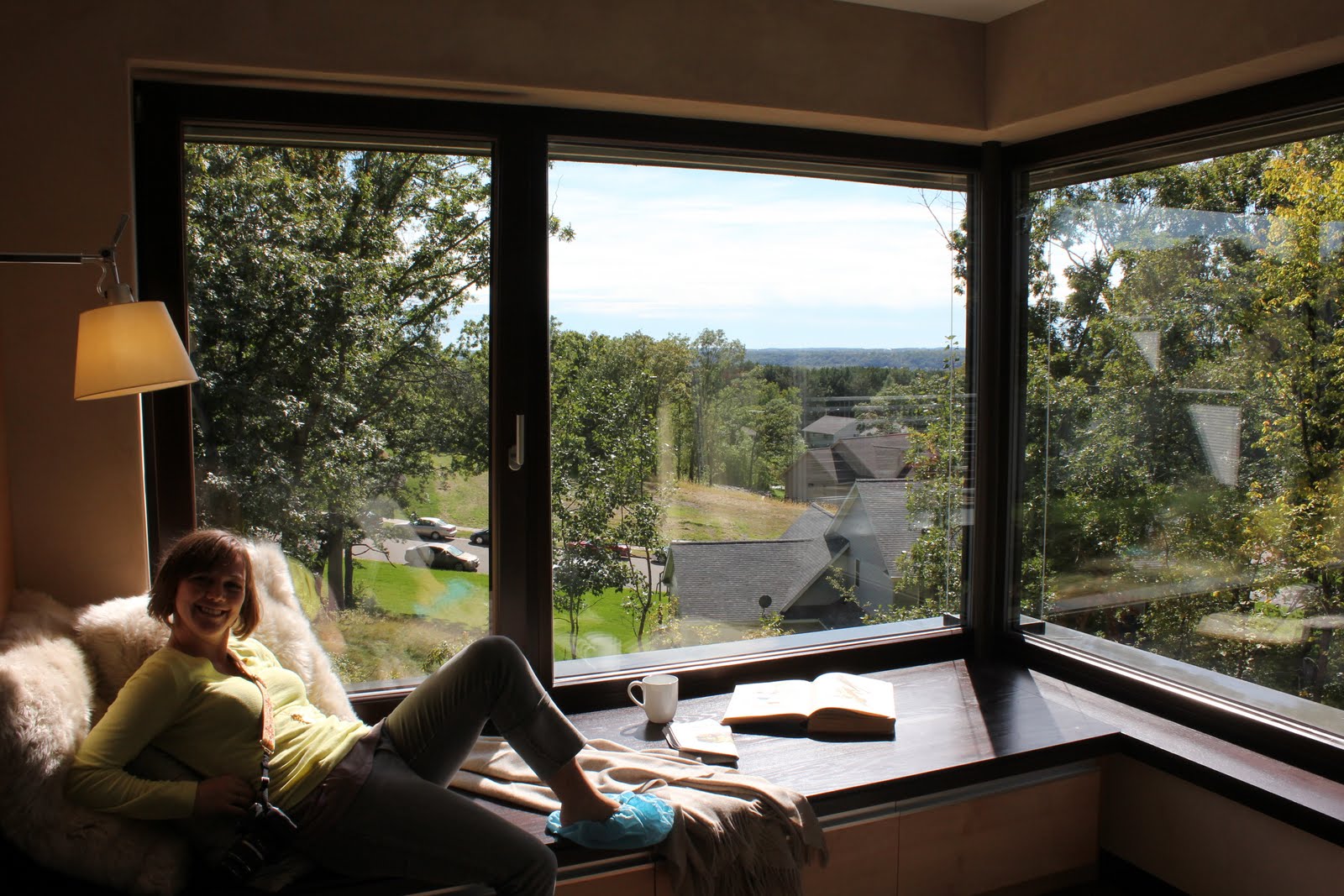
We went to tour the Passive House In The Woods today, which is located in Hudson, Wisconsin.  Yes, I had to drive there :/  First time in a car in 35 days.  But don't worry, we carpooled.  The house is a 3-bedroom, 3 level 1,940 square foot house with a rooftop terrace and many walk out balconies facing into the woods.  It is located on the edge of a cookie-cutter suburban neighborhood.  While the view from the house shows the St. Croix river valley, you have to look past all the rest of the suburban development first, which makes for an interesting contrast of building types.  We thought it should have been called Passive House in the Suburbs ;).  It was designed by a design team at TE Studio

According to their website, "The project is designed to the Passive House Building energy standard, which currently represents the tightest energy standard in the world. Passive House in the Woods actually exceeds space-conditioning requirements for Passive House by 25%.  Currently, there are a little over one dozen certified Passive House™ buildings in the U.S. The Passive House in the Woods is slated to become the first certified Passive House™ in Wisconsin, and one of only a few net energy positive and carbon-neutral buildings in the country."

The main idea for this kind of Passive House  (capital P)  is its high performance building envelope.  By super insulating with 12" of Polystyrene and 11" of Insulated Concrete Forms, the entire building envelope can dramatically reduce the amount of energy used to condition a building.  The walls have an insulation value of R-60 and the roof R-95.  The mechanical system in the house is heat-recovery ventilation, which pre-heats and pre-cools the incoming air.  Because the house has such ridiculously high insulation values, hardly any heat is allowed to escape once introduced into the space.  Electric in-floor heating mats take care of the rest of the heating, no boiler, no furnace.  While not required by the Passive House standards, the Passive House in the Woods also has two solar arrays which cover the entire electricity need and make the house net-energy positive (sells money back to the grid).  It is a 4.7 kW array which (with 4.6 hrs of peak sun in MN) I'm guessing produces about 21 kWh/day (643.6 kWh/month).  For comparison, the electric bill for my 3 bedroom house is around 180 kWh/month  (granted, the Passive House is 3 levels).  There is also a 40 square foot solar hot water collector on the roof.

It was interesting to walk through the house with my roommate Abby who designed and built a passive house (lower case p) for her parents in Alberta.  The philosophies behind the house she built and the Passive House standards(http://www.passivehouse.us/passiveHouse/PHIUSHome.html), demonstrate quite different approaches to sustainable and 'passive' building.  She designed her parent's house to have a long east-west axis with the south face oriented to the sun.  The entire south side has large expanses of windows which capture the solar energy which is stored as heat as it hits the massive concrete slab floor inside.  The BACKUP system is a geothermal radiant floor system.  It's a beautiful house which is more or less symmetrically divided to have two wings, one for her parents and one for her aging grandparents who recently moved in. 

While the Passive House in the Woods has south exposure, it seemed a bit misleading to claim that was a 'passive' feature of the house because there was no thermal mass to capture any of this solar heat/light.   The primary heating source was in-floor heating mats, and the heat recovery ventilation.  The super insulation part could definitely qualify as a "passive" system, but the rest of the systems were what I understand as "active" systems (mechanical additions to the space in the form of the Heat Recovery Ventilation, heating mats, and solar array).  In the same way, we could criticize Abby's house as not being entirely passive because it had the geothermal radiant heat.  However, Abby's house had active systems only as a backup, with the primary heating system being the passive solar energy gained through the south facing windows and stored in the concrete floor.  I'm not sure 'passive' is the right term for the method of building demonstrated in the Passive House in the Woods. 

Another thing to note is that Polystyrene is a petroleum product.  While there are many other options for insulation in buildings, how will super insulation occur without this product? What other products could be used in a post-cheap oil world to carry on this type of building? 

I'm not sure, but its seems that if a truly 'passive' system could be achieved (designing a home to capture and take advantage of the free energy resource of the sun-THAT would be a better goal than relying on the efficiency of building materials such as polystyrene super insulation + mechanical systems.

Sunday, September 19, 2010

DAY 34_CYCLOPATH

17 September 2010

My fabulous friend Amber recommended me this website for finding bike routes through Minneapolis. 

http://www.cyclopath.org/

Cyclopath allows you to put in your preferences as far as; quickest route vs most bikable route, hill slope, only bike paths vs busy streets.  It can be modified by anyone living here so there is quite a bit of detail as far as what part of the route is good or bad and so on.  Awesome site, can't believe I never knew this existed. 

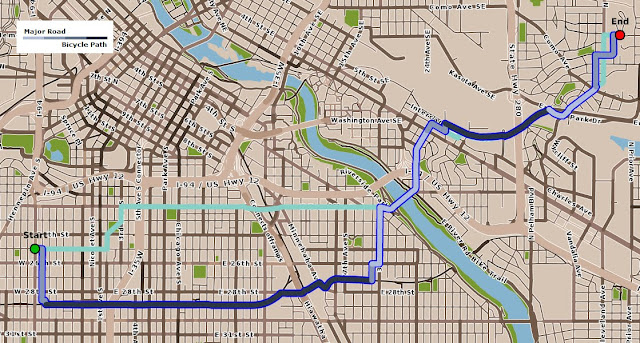
I mapped my route from Uptown to the University of Minnesota St. Paul campus (most frequent commute route). 


route by byway type (bike paths vs busy streets)
 

slope of route

Google maps also has a bike route function for those of you who don't live in Minneapolis, or didn't know. 

Its been raining quite a bit this week.  The other night the rain was pelting so hard it felt like hail.  I have to do more laundry when it rains because all the junk off the street gets all over my clothes. 

There are some strange forces of the earth that allow it to typically rain hard ONLY when I am on my bike.  My advisor, Virajita says she can tell if its going to rain if she knows I am biking around ;)  Fabulous.


DAY 33_FOOD ENERGY (A LOAF OF BREAD)

16 September 2010

While my initial requirements for food were; eating locally and organically (to avoid long-range transportation and petroleum-based fertilizers), I've come to understand that food is also a huge energy user.

This article (Energy Use in the U.S. Food System, by Patrick Canning, Ainsley Charles, Sonya Haung, Karen R. Polenske and Arnold Wasters, ERR-94, USDA Economic Research Service, March 2010, available at www.ers.usda.gov/publications/err94) is an interesting introduction to the huge amount of energy is used in food every year from; agricultural machinery and fuel for these machines, transportation of food, food processing, food packaging, ovens, stoves, microwaves, home appliances, and even down to the cookware used to make food. 

As the article states, "In 2007, the U.S. food system accounted for almost 16 percent of the Nation's energy budget." and "Between 1997 and 2002, over 80 percent of the increase in annual U.S. energy consumption was food related."  They identify three main reasons why-even as other energy use has remained stable-food related energy has increased so dramatically. 

(1) Population growth has accounted for 25% of food-related energy use.  Our nationwide population has grown by more than 14 million in give years from 1997 to 2002. More mouths to feed.

(2) While there has been a greater proportion of foods that used less energy (fresh produce, fish...) purchased over energy-intensive processed foods, this change came with a "substantial increase in food marketed per capita to U.S. consumers)  People are eating more food.

(3) We are using more energy-intensive technologies which account for about half of the increase in food-energy.  "Businesses faced with increasing labor costs, while energy prices were lower...A shift from human labor to energy-using equipment occurred for all food and food-related commodity groups."  More and more household are adopting labor-laving technologies to save time preparing food and cleaning it.  "In 1985, 18-64 year olds spent an estimated average of 49 minutes on cooking and cleanup per day.  Dureau of Labor Statistics' data indicate average cooking and cleanup times per household fell to 31 minutes per day in 2008." 

I wanted to analyze the energy it takes to produce one loaf (1 kg) of bread with various at home  methods and industry methods. This first chart shows an energy comparison of only the BAKING energy used (in kWh) for 4 different scenarios: Quick bread (tortillas from earlier post), Bread machine, Manual kneading+Oven baking (at 350 degrees for 1 hour) and Industrial baking. 

As you can see, cooking in the oven actually uses more energy (2 kWh) than industrial baking (.7 kWh).  This is due to the high volume of bread being made in industrial kitchens.  Baking is only a small part of the energy it takes to create a loaf of bread, however. What is interesting, is a comparison of the TOTAL energy it take to create this loaf of bread, looking at all stages of its life cycle.  I used this article (Andersson, K., and T. Ohlsson. (1999) “Life Cycle Assessment of Bread Produced on Different Scales.” International Journal of Life Cycle Assessment 4(1): 25-40.) for my numbers. 

The two scenarios I looked at in this chart were an 'Industry' produced loaf of bread (example Sara Lee or Pepperidge farm), versus a 'Home' scenario which ingredients are bought in bulk, and are all local.

_'Consumer phase' refers to how much energy it takes to operate the shopping side of obtaining the bread (grocery store lighting and heating etc),.
_'Packaging phase' is limited in my 'home' scenario because I am buying everything in bulk, there is still a small amount of packaging which food is in when it arrives at the store. 
_'Transportation' phase is also limited in the 'home' scenario because I am buying all ingredients locally
_'Food Processing' phase refers to the amount of energy it takes for all processing and baking
_'Agriculture' phase is the same for both scenarios because they are using the same ingredients.

In the end, the 'Industry' scenario used 3.61 kWh to produce one loaf of bread and the 'Home' scenario used 2.02 kWh.  The 1.59 kWh saved for each loaf of bread comes from the decreased travel distance (local ingredients) and the lack of packaging (bulk foods). 

I also read the following articles when researching this, both very interesting:
 Life Cycle Assessment (LCA) of the Production of Home made and Industrial Bread in Sweden
http://www.infra.kth.se/fms/utbildning/lca/projects%202006/Group%2003%20(Bread).pdf

Life-Cycle Based Sustainability Indicators for Assessment of the U.S. Food System:
http://css.snre.umich.edu/css_doc/CSS00-04.pdf

Friday, September 17, 2010

DAY 32_LOCAL BREWERIES AND WINERIES

15 September 2010
I got called out by my thesis committee the other night drinking a beer.  Most beer made locally isn't actually 'local' because many of the crucial ingredients (malts, hops) are from all over the country and world.  In search of a truly local beer we will be having a local dinner where everyone brings a local (Minnesota) beer/wine.  The catch is I am trying to get everyone to research where each brewery sources its ingredients.  For example, St. Croix Brewing Co is the first beer in the nation to ferment with pure maple syrup (which have plenty of locally).  It will be interesting to see if there are any truly local beers (all ingredients grown and harvested locally). 

Following is a list of local breweries/wineries that I have discovered over the course of this project, I'm sure there are more.  Also, many of these breweries offer beer in growlers (jug beer) which are returnable-thus creating no waste! 

_Surly (Brooklyn Center, MN, no relation to bikes) http://www.surlybrewing.com/
_Lift Bridge (Stillwater, MN) http://www.liftbridgebrewery.com/
_Town Hall (Seven Corners Minneapolis)
_Great River's (St. Paul)
_Brau Brothers (Lucan, MN) http://www.braubeer.com/
_Cold Spring (Cold Spring, MN) http://www.coldspringbrewery.com/
_Finnegans Irish Amber (one produce one beer, but 100% of profits to to help the working poor and at rish youth, brewed by Summit) http://www.finnegans.org/
_Fulton (Minneapolis's newest brewery) http://www.fultonbeer.com/
_Lake Superior Brewing Co (Duluth, MN) http://www.lakesuperiorbrewing.com/
_Mantorville Brewing Co (Mantorville, MN) http://www.mantorvillebeer.com/
_Pig's Eye Brewing Co. (St. Paul) http://www.pigseyebeer.com/
_August Schell Brewing Co (second oldest family-run brewery in the US, survived the prohibition!)http://www.schellsbrewery.com/
_St. Croix Brewing Co (St. Paul-first american beer fermented with pure maple syrup)  http://www.stcroixbeer.com/
_Vine Park Brewing Co. (St. Paul-growlers only?) http://www.vinepark.com/

WINE:
_Alexis Bailly (Hastings)
_Cannon River Winery (Cannon Falls)
_Carlos Creek Winery (Alexandria)
_Falconer Vineyards (Red Wing)
_Fieldstone Vineyards (Morgan)
_Forestedge Winery (Laporte)
_Goose Lake Farm (Elk River)
_Luedke's Winery (Princeton)
_Minnestalgia Wines (haha McGregor)
_Morgan Creek Vineyards (New Ulm)
_Northerm Vineyards (Stillwater)
_Olde County Winery (Lake Lillian)
_Saint Croix Vineyards (Stillwater)
_Santiago's Winery (Alexandria)
_Scenic Valley (Lanesboro)
_Winehaven (Chisago City)
_Beven's Creek Vineyard and Nursery (Carver)
_Crofut Family Winery (Peterson)
_Glacial Ridge Winery (Spicer)
_Great River Vineyard (Lake City)
_Millner Heritage Vineyard (Kimball)
_Post Town Winery (Byron, MN)
_Salem Glen Vineyard (Rochester)
_Two Fools (Plummer)
_Whitewater Wines (Plainview)
_Winterhaven Vineyard (Janesville)
_Woodland Hill Winery (Delano)

 Surprised that we have wineries in Minnesota? So was I.  Many of the wines are made from Frontenac grapes, which are a local cold-weather grapes.  Check out your area for local wineries, I think you'd be surprised. 

Thursday, September 16, 2010

DAY 31_TEFLON (THE PETROLEUM IN YOUR PAN)

14 September 2010

Teflon (the non-stick coating in pans) has been a subject of some controversy in our house lately ;)-being a petroleum product, I think it deserves some attention here....

I'll use this nice introduction from www.wisegeek.com/what-is-teflon.htm:

"Teflon as been a familiar name for decades.  Invented at DuPont's Jackson Laboratory in 1938, Teflon is actually a substance called polytetrafluoroethylene (PTFE), which is considered to be the most slippery substance that exists.  Its nonstick properties have transcended the kitchen, and is widely used in other areas including aerospace, communications, electronics, industrial processes, and architecture. Teflon changed the plastics industry forever, and DuPont has received numerous awards and recognitions for its contribution to the field of man made polymers.

Its likely that just about every home in America has Teflon somewhere.  As a carpet protector, it repels liquids so that nasty spills on carpet can be wiped up clean without leaving a stain.  The same technology can also protect the fabric on furniture.  It is also used as an automotive lubricant, and even protects bulbs from shattering. 

There are numerous industrial uses for Teflon as well, in areas such as semiconductor, manufacturing, pharmaceutical and biotech manufacturing, and industrial bakeware.  Eyeglass wearers may even have Teflon on their eyeglass lenses.  In the area of personal care, it is used as a fingernail protector, and even in a line of haircare products.  Teflon is applied to pots and pans in a multi-step process that helps ensure that the material stays stuck to the surface.  The first applied layer includes a sticky molecule that helps adhere the non-stick Teflon to the surface, this is followed by an application of non-stick surface only, and the final coating is a combination of non-stick Teflon with other hardeners."

There are varying opinions about the safety of Teflon for the environment and communities located near manufacturing plants:

"The Environmental Protection Agency (EPA) asserts that DuPont has purposely withheld health hazardous information regarding Teflon since the early 1908's.  Petroflouronanoic acid (PFOA), a chemical used to produce Teflon, has been appearing in blood samples of people world wide.  DuPont, slapped with approximately 300 million dollars in fines, has agreed to pay a 108 million dollar lawsuit brought about by residents near one of its company plants as elevated levles of PFOA's have been found in surrounding drinking water supplies. "
(http://whatscookingamerica.net/LindaPosch/ToxicCookware.htm)

While causing environmental air/water quality problems is one things, its daily use is another...All plastics are in their most stable state when they are solids.  While they off-gas a small amount as solids, once they are heated they begin off gassing quite a bit more.  A new car smell is actually the plastic elements and other chemicals (in seating fabric etc...)that are being off-gassed as they sit in the hot sun in an unventilated place (closed car).  The same is true with Teflon cooking pans. 

There is signicifant evidence that the fumes are toxic enough to kill birds:

"In cases of "Teflon toxicosis," as the bird poisonings are called, the lungs of exposed birds hemorrhage and fill with fluid, leading to suffocation.  DuPont acknowledges that the fumes can also sicken people, a condition called "polymer fume fever." DuPont has never studied the incidence of the fever among users of the billions of non-sick pots and pans sold around the world.  Neither has the company studied the long-term effects from the sickness, or the extent to which Teflon exposures lead to human illnesses believed erroneously to be the common flu.  The government has not assessed the safety of non-stick cookware.  According to a Food and Drug Administration (FDA) food safety scientists. "You won't find a regulation anywhere on the books that specifically addresses cookwares," although the FDA approved Teflon for contact with food in 1960 based on a food frying study that found higher levels of Teflon chemicals in hamburger cooked on heat-aged and old pans.  At the time, FDA judged these levels to be of little health significance.

Of the 6.9 million bird-owning households in the US that claim an estimated 19 million pet birds, many don't know that Teflon poses an acute hazard to birds.  Most non-stick cookware carries no warming label.  DuPont publicly acknowledges that Teflon can kill birds, but the company-produced public service brochure on bird safety discusses the hazards of ceiling fans, mirrors, toilet, and cats before mentioning the danger of Teflon fumes.

As a result of the new data showing that non-stick surfaces reach toxic temperature in a matter of minutes, EWG has petitioned the Consumer Product Safety Commission (CPSC) to require that cookware and heated appliances bearing non-stick coatings must carry a label warming of the acute hazard the coating poses to pet birds.  Additionally, EQG recommends that bird owners completely avoid cookware and heated appliances with non-stick coatings.  Alternative cookware includes glass, stainless steel and cast iron, neither of which off-gases persistent pollutants that kill birds."

While there are conflicting opinions about the temperature at which the Teflon fumes begins to become toxic: Wikipedia sources say 260 C degrees is when it begins to deteriorate and at 350 C it decomposes.  Other sources say the Teflon begins to off-gas at lower temperatures.  It is likely that these numbers are determined by what is a 'safe' level of toxins to be in the air without have negative side effects.

No matter what the true off-gassing answer is, the point remains that Teflon is a toxic chemical, and not something that should be on objects that are INTENTIONALLY heated-cooking pans.

Lastly in ALL studies done on Teflon which I have encountered, it is stated that Teflon is safe when 'properly used'.  How to 'properly use' your pan is either not included or in the fine print.  Deeper research (and personal experience) reveals that Teflon is quite destructible.  It is not intended to be coming off the pans, and when it does, it becomes an even greater hazard than inhaling possible toxic fumes.  EATING Teflon flakes isn't exactly something you want to do. 

"One of the major disadvantages of using Teflon cookware is that it must be treated very carefully or the non-stick coating can be marred or destroyed.  Teflon pans should never be used with metal utensils.  If you tend to cut meat or vegetables directly in the pan, steer away from using Teflon!" (http://tuberose.com/Teflon.html.)

Basically, if you own Teflon pans, do not:
_scrape the food off the pan
_cut the food on the pan
_store the pan anywhere it can be scratched in any way (stacking pots)
_leave the pan in the sink where other dishes (silverware) can scratch it

Ultimately, with other options of pan materials available to us (cast iron, ceramic, stainless steel and aluminum), why risk possible health problems for a little added (non-stick) convenience?

I have been forced to abandon a multitude of habits and methods of doing things during the course of this project that I consider to be more convenient: turning on tap water, turning on a light, taking a long shower, buying personal care products from anywhere in the world that last for years, getting in a car, picking up pre-made food in boxes...While only some of these habits DIRECTLY negatively affect our health and lives, many indirectly do as they effect the environment in which we live.  Finding alternatives for these ways of life is often difficult, however, finding other methods for at least the habits which are direct risks to our health seems like a good starting point.

Petroleum use has certainly increased the 'convenience' of our daily lives, but at what cost?  At the risk of sounding preachy, it has been an amazing experience up to this point to slow down and spend time doing some of the everyday tasks that I normally rushed through.  Doing laundry, taking a long time to make dinner (because it takes a long time to make everything from scratch :P), and commuitng by bike are all tasks which, on one had eat time out of my day, and on the other hand allow me to appreciate and understand where many of the things I originally took for granted are coming from, and the energy it takes to accomplish these tasks for my 'convenience'.

As my chair, Tom Fisher puts it, we need to redefine what the word 'scarcity' and 'abundance' really mean in our society.  What is it that we value and brings us happiness in our lives?  Is our current definition of 'abundance' representative of the way we really want to be living?