25 October 2010
We've been getting some crazy weather here lately....
This morning we had a light sprinkle of rain and the temp was around 55. By the afternoon, however, winds were consistently 30 mph with gusts of 50 mph and the temperature had dropped 20 degrees (during the day!) to 35. Planning my bike home to when there was a break in the rain, I rode home realizing that transporting myself around during the rest of this project isn't going to get any easier...
While I didn't get rained on riding home, we found ourselves riding against 30 mph winds. Turning what is typically a 25 min commute (6-miles) into a 50 min one. Turning around a corner anytime I was going west STOPPED my bike. And swirling gusts of 50 mph wind literally blew me sideways off the trail (yeah I was in the grass). We were afraid to bike next to each other and rode behind to avoid blowing into each other. Pretty scary conditions to be biking in. I quarantined myself into my house the entire next day (which was also really gusty, powerful winds), refusing to go out and risk my life on the road :/ I found out later that day that the crazy weather was caused by the lowest barometric pressure on record being set at 28 some in Hg. Always one for a bit of history, my mom sent me this email,
"I heard on the news this am that we here in Minnesota have just experienced the lowest barometric pressure drop in recorded history! This has created ridiculous winds – comparable to a category 3 hurricane. The previous lowest drop in barometric pressure ever recorded happened during the storm system that sank the Edmund Fitzgerald on Lake Superior in 1974. Yesterday, there were already 15-20 swells on Lake Michigan, so we will see what today brings…"
On top of that, the first 32 degree temperature was reached this Friday morning, October 29, tied for the 9th latest below freezing temperature in the Twin Cities (http://minnesota.publicradio.org/collections/special/columns/updraft/). It really surprised me to hear that we have seen a warmer October than usual (the average first 32 degree temperature is Oct 6th). I think this just illustrates how much more connected I am to the weather day-to-day than I have been every before in my life, it never seemed this colder before! Each morning I check, not only only the temperature, but also be sure to take note of the wind speed and direction. I know I'm going to have a tough ride in the morning if there are strong eastern winds. While people are generally concerned with what the highest daily temperature is, I more often care what the LOW is. I end up biking in almost the lowest temperature every morning leaving around 7:30am.
This article on MPR's website (http://minnesota.publicradio.org/collections/special/columns/updraft/) mentions that snow might be a possibility during the project (ending nov 22nd). As they say:
"It's wayyyy out in the medium range forecast models and could be pure fiction at this point...but the models are hinting at the potential for our first big snow in southern Minnesota the weekend of November 13-14."
Crossing my fingers that that won't happen. While its already cold, dealing with ice and snow on the ground would be an even more precarious biking situation.
We are also slowly and steadily getting less daylight. When I am leaving in the morning now it is just dark enough to want to have bike lights on, and I try to make sure the leave campus before it gets dark. It's getting more stressful to ride when I feel like I am less visible to drivers.
EVERYTHING gets harder when it gets dark, and cold.

Friday, October 29, 2010


Wednesday, October 27, 2010
DAY 71_YOU'RE ALSO BUYING THE CONTAINER
24 October 2010
My collection of containers has been slowly but steady growing throughout this project. Every couple weeks I seem to find a few items that come in bulk or reusable containers that I wasn't aware of before. Many items we typically buy in a grocery store come in glass containers, but before this project I never though twice about recycling containers when their contents were empty, they simply didn't mean anything to me anymore. The fact is, whatever we are buying we are PAYING for that container as well as the contents inside it. I have begun to feel much more connected to the containers I am buying because I have actually purchased them in the form of; mason jars, growlers or milk containers.
 I have some old jars that belonged to my great grandmother which she reused over and over to store foods that she made or bought. They are decorations, as they may be in other people's homes as well. They are just jars like the ones I buy, but because they are old they have a value that I don't associate with my new jars. By actually placing value on the containers, whether nostalgic or monetary- I am much more aware of the waste I am avoiding creating.
In the case of the mason jars which are less than $1 each, I may not be paying much more for the container buying it separately and getting bulk foods than I would be buying an item in a glass jar similar to it. In fact, because I only have to buy the container ONCE, the cost really pays for itself quite quickly. The milk jugs and growlers are a bit different. Each time I return a milk jug or growler I am refunded a deposit for the empty container and make a new deposit on the new container. The deposit for my milk jug is $1.50 and the growler is $4. In this way, I am really not paying for the container, but simply renting it. By placing only a small monetary value on containers they suddenly become much more precious.
In our house, if a few of us end up buying the same milk we make sure to keep the number of milk jars that belong to each person straight . In the same way, the growlers of beer are taken home by the people who brought them after a party. A friend bought a jug of milk for me the other day in one such container. After he dropped it off and left I realized that he had not only bought my milk but also paid the deposit on a container that I now had. I felt kind of guilty. When was the last time you left a jar of pickles at someone's house and they made sure you got the glass container when they were done with them? It wierd, buts it kind of nice. Placing value on more of the things we own I believe makes us increasingly aware of the value of every item. There is quite a bit of energy that went in to making all that packaging, the price reflects it, but we typically throw away this packaging without a thought. In a way, this also makes people more aware and responsible for the waste they create. Even $1.50 on a milk jug is enough to want to bring it back to the grocery store each time and trade it in instead of simply recycling it.
Below are some images of the reusable containers I have collected and the waste that is avoided by using them:
My collection of containers has been slowly but steady growing throughout this project. Every couple weeks I seem to find a few items that come in bulk or reusable containers that I wasn't aware of before. Many items we typically buy in a grocery store come in glass containers, but before this project I never though twice about recycling containers when their contents were empty, they simply didn't mean anything to me anymore. The fact is, whatever we are buying we are PAYING for that container as well as the contents inside it. I have begun to feel much more connected to the containers I am buying because I have actually purchased them in the form of; mason jars, growlers or milk containers.

In the case of the mason jars which are less than $1 each, I may not be paying much more for the container buying it separately and getting bulk foods than I would be buying an item in a glass jar similar to it. In fact, because I only have to buy the container ONCE, the cost really pays for itself quite quickly. The milk jugs and growlers are a bit different. Each time I return a milk jug or growler I am refunded a deposit for the empty container and make a new deposit on the new container. The deposit for my milk jug is $1.50 and the growler is $4. In this way, I am really not paying for the container, but simply renting it. By placing only a small monetary value on containers they suddenly become much more precious.
In our house, if a few of us end up buying the same milk we make sure to keep the number of milk jars that belong to each person straight . In the same way, the growlers of beer are taken home by the people who brought them after a party. A friend bought a jug of milk for me the other day in one such container. After he dropped it off and left I realized that he had not only bought my milk but also paid the deposit on a container that I now had. I felt kind of guilty. When was the last time you left a jar of pickles at someone's house and they made sure you got the glass container when they were done with them? It wierd, buts it kind of nice. Placing value on more of the things we own I believe makes us increasingly aware of the value of every item. There is quite a bit of energy that went in to making all that packaging, the price reflects it, but we typically throw away this packaging without a thought. In a way, this also makes people more aware and responsible for the waste they create. Even $1.50 on a milk jug is enough to want to bring it back to the grocery store each time and trade it in instead of simply recycling it.
Below are some images of the reusable containers I have collected and the waste that is avoided by using them:
 |
| 4 bottled beers saved by a reusable growler from a local brewery |
 |
| milk cartons (not recyclable) saved by a glass milk jar |
 |
| egg cartons to buy 'by-the-egg' at the co op |
 |
| various sized reuable jars replace baking packaging waste |
 |
| elimination of uncessary and excessive packing of individual tea packets (bulk with tea infuser) |
DAY 70_THE TIME HAS COME FOR KILLING
23 October 2010
Watering my plants today I noticed some strange green blobs. Very small, and on the underside of leaves. APHIDS! Upon closer inspection, they were almost covering the stem of one of my cilantro plants (that has already made a miraculous recovery from being improperly transplanted). I have no idea how aphids got into an indoor garden when the windows are never open? Not a problem I thought I would run into with the grow table. So I got out the garden book....
I've heard you can get rid of aphids and other pests by spraying a light mixture of soapy water on the plants. This kills the bugs, but it also can take it's toll on the plants if you aren't careful. The Vegetable Gardener's Bible by Edward C. Smith, addresses ways to manage insect pests in a natural way by "creating a garden environment where creatures that protect plants and help them to grow outnumber and help to control the creatures that eat plants or disturb their growng; its all about creating an ecologically balanced garden" (157).
Insect pests prefer sickly plants to healthy ones, attacking the easiest prey (which may explain why they went after the cilantro). Stressed plants can be caused by fluctuations in soil or air temperature, to little or too much water, not enough nutrients, compacted soil or wrong PH. In this way, pests are 'symptoms' of a larger problem - the health of the plants.
Other tips from the book include:
_rotating plants from one part of the garden to another after each crop cycle
_deterring pest with herbs and flowers that have powerful scents (onions, garlic and chives)
_avoid planting all of the same type of plant in the same area (this makes it easy for pests to find what they want)
_avoid pairings such as (corn + tomatoes, potatoes + tomatoes +peppers + eggplant, and cucumbers + squash+ melons +pumpkins) which the same pests are attracted to.
_introduce beneficial predators such as; ladybugs, assassin bugs, parasitic wasps
However, if all else fails, as Edward Smith says in his Bible, "There's no nice way to say it: The time has come for killing." This, of course, should be done in a way that doesn't kill the beneficial bugs if possible. There are several methods for this:
_Hand picking. Place them in a tin full of water and a little soap so they are sure to die. The best hunting time is early morning, the bugs are "logy and tend to fall right off the plants and into the water. I turned my plants over and rinsed the leaves completely, then hand picked any others I could see. I mean, they are green so I can't be sure :)
_Natural or other pesticides, "we can't get away from the fact that pesticides we apply to our crops are poisons, whether they come from a chemistry lab or, like phyrethrum, from a daisy. Some botanical pesticides appear to do their work with few drawbacks: Garlic spray and hot pepper wax repel pests; insecticidal soap and neem usually kill pests without injuring other life-forms.
So that's all well and good. However, my garden is inside, meaning many of the 'solutions' proposed here are not applicable. I don't have the option of introducing beneficial insects without running the risk of them taking over the house. I can't really rotate my crops as they are all in pots. And, really? How did I get aphids in the first place? One culprit may be the greens I bring home from the grocery store. I've taken to the habit of placing them in a vase of water on the grow table instead of refrigerating them to save space in the fridge.
After inspecting all my plants closely, it seems that none of the vegetables were affected except a hot pepper plants I got from the farmer's market this summer. The greens got hit hardest. This is strange because the greens and the cilantro are on opposite sides of the table, meaning the aphids somehow went over the vegetables and only chose to attack the greens. The greens are a problem because it isn't easy to just pick or wash the aphids off. It is a jungle in there. Because I planted them as 'microgreens' they are extremely close together and hard to pick through. I'm not sure what I think about the micro greens anyway because they aren't really growing the way I assumed they would. Maybe I am planting the wrong crops to use as micros, but the collards, arugula and romaine are still not really tasting that great and are still quite small. My single romaine plant that is almost 8" tall after 70 days of growing, and the small micro-romaines are only about 4", still not ready to eat.
I am going to quarantine the micro greens at this point and treat them with a soap mixture spray. If they don't get better, its not a huge loss, and think that growing the single plants might be a better option anyway....
It hasn't been all bad in the garden lately, however. I have a green bean which I planted in a 3 gallon pot (to see if planting in large pots helps growth immediately). It literally grow before my eyes after popping out of the soil just 2 days ago and is now close to 3 inches tall! I also have a tomato and onion sprout that are looking good so far...
Watering my plants today I noticed some strange green blobs. Very small, and on the underside of leaves. APHIDS! Upon closer inspection, they were almost covering the stem of one of my cilantro plants (that has already made a miraculous recovery from being improperly transplanted). I have no idea how aphids got into an indoor garden when the windows are never open? Not a problem I thought I would run into with the grow table. So I got out the garden book....
 |
| aphids on the cilantro |
Insect pests prefer sickly plants to healthy ones, attacking the easiest prey (which may explain why they went after the cilantro). Stressed plants can be caused by fluctuations in soil or air temperature, to little or too much water, not enough nutrients, compacted soil or wrong PH. In this way, pests are 'symptoms' of a larger problem - the health of the plants.
Other tips from the book include:
_rotating plants from one part of the garden to another after each crop cycle
_deterring pest with herbs and flowers that have powerful scents (onions, garlic and chives)
_avoid planting all of the same type of plant in the same area (this makes it easy for pests to find what they want)
_avoid pairings such as (corn + tomatoes, potatoes + tomatoes +peppers + eggplant, and cucumbers + squash+ melons +pumpkins) which the same pests are attracted to.
_introduce beneficial predators such as; ladybugs, assassin bugs, parasitic wasps
However, if all else fails, as Edward Smith says in his Bible, "There's no nice way to say it: The time has come for killing." This, of course, should be done in a way that doesn't kill the beneficial bugs if possible. There are several methods for this:
_Hand picking. Place them in a tin full of water and a little soap so they are sure to die. The best hunting time is early morning, the bugs are "logy and tend to fall right off the plants and into the water. I turned my plants over and rinsed the leaves completely, then hand picked any others I could see. I mean, they are green so I can't be sure :)
_Natural or other pesticides, "we can't get away from the fact that pesticides we apply to our crops are poisons, whether they come from a chemistry lab or, like phyrethrum, from a daisy. Some botanical pesticides appear to do their work with few drawbacks: Garlic spray and hot pepper wax repel pests; insecticidal soap and neem usually kill pests without injuring other life-forms.
So that's all well and good. However, my garden is inside, meaning many of the 'solutions' proposed here are not applicable. I don't have the option of introducing beneficial insects without running the risk of them taking over the house. I can't really rotate my crops as they are all in pots. And, really? How did I get aphids in the first place? One culprit may be the greens I bring home from the grocery store. I've taken to the habit of placing them in a vase of water on the grow table instead of refrigerating them to save space in the fridge.
After inspecting all my plants closely, it seems that none of the vegetables were affected except a hot pepper plants I got from the farmer's market this summer. The greens got hit hardest. This is strange because the greens and the cilantro are on opposite sides of the table, meaning the aphids somehow went over the vegetables and only chose to attack the greens. The greens are a problem because it isn't easy to just pick or wash the aphids off. It is a jungle in there. Because I planted them as 'microgreens' they are extremely close together and hard to pick through. I'm not sure what I think about the micro greens anyway because they aren't really growing the way I assumed they would. Maybe I am planting the wrong crops to use as micros, but the collards, arugula and romaine are still not really tasting that great and are still quite small. My single romaine plant that is almost 8" tall after 70 days of growing, and the small micro-romaines are only about 4", still not ready to eat.
I am going to quarantine the micro greens at this point and treat them with a soap mixture spray. If they don't get better, its not a huge loss, and think that growing the single plants might be a better option anyway....
It hasn't been all bad in the garden lately, however. I have a green bean which I planted in a 3 gallon pot (to see if planting in large pots helps growth immediately). It literally grow before my eyes after popping out of the soil just 2 days ago and is now close to 3 inches tall! I also have a tomato and onion sprout that are looking good so far...
 |
| quarantined micro greens |
 |
| single potted romaine after 70 days |
 |
| weeds! another indoor garden problem I didn't think I would have |
 |
| green bush been growth after only 2 days! |
 |
| survivors |
 |
| spinach micro greens after 30 days of growth |
Monday, October 25, 2010
DAY 69_LOCAL BIRTHDAY DINNER PARTY!
22 October 2010
My friend Kevin (who I have thoroughly brainwashed throughout the course of this project) had an all local-food/drink dinner party tonight for his birthday. Throwing a few 3'x6' plywood boards on some cinder blocks he made a make-shift table to seat 18 people in his 1 bdrm apt. Who says you need a big place or exotic foods to throw a great dinner party?
I helped him cook up some local foods for the party as follows:
Pizzas:
All Crusts:
1_let rise in a warm place for 30 min
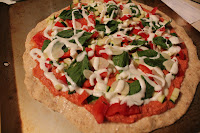 Spicy Tomato Sauce + Goat Cheese Pizza:
sauce:
4 Roma tomatoes
toppings:
tomatoes (guts taken out)
goat cheese
sliced garlic
hot peppers
 Pear +Gorganzola Pizza
_carmelize onions in a liberal amount of oil
_toss with diced pears in frying pan for last 5 minutes
_spread mixture over pizzas
_top with chopped walnuts and garlic slices
 Pesto Pizza
Pesto:
1/2 cup butter
1/4 pure maple syrup
2 tbsp maple sugar
2-3 cups powdered sugar
3_ In a large bowl, mix together the flour and the ginger and set aside.
4_In a large bowl, cream the butter and the sugar until fluffy.
5_ Add the eggs one at a time, beating until well combined.
6_Beat in the maple syrup gradually.
7_Add the flour mixture in thirds, alternating with the water, beating after each addition until smooth.
8_Pour the batter into the prepared pans; prepare a hot water bath to be placed on the rack underneath the cake pans. Bake for 30-35 minutes or until cake tests done (the toothpick test).
9_Let cakes cool in pans for 10 minutes. Remove from pans and cool completely on wire rack.
10_To make the buttercream frosting: mix butter, extract and syrup till smooth. Add powdered sugar (a few tablespoons at a time), beating on high speed (my handmixer has three speeds) till frosting reaches desired consistency.
11_When cake has cooled, ice between the layers. Ice top and sides of cake, sprinkling the top with chopped walnuts.
He asked everyone to bring a local wine or beer. Many people brought growlers of beer from local breweries which was great, no glass waste! A few people tried their hand at cooking some local dishes as well which were all excellent:


My friend Kevin (who I have thoroughly brainwashed throughout the course of this project) had an all local-food/drink dinner party tonight for his birthday. Throwing a few 3'x6' plywood boards on some cinder blocks he made a make-shift table to seat 18 people in his 1 bdrm apt. Who says you need a big place or exotic foods to throw a great dinner party?
I helped him cook up some local foods for the party as follows:
Pizzas:
All Crusts:
1 1/2 cups water
2 tbsp sunflower oil
2 tsp maple sugar
4 cups flour (3 cups white, 1 cup whole wheat)
4 tsp active bread yeast1_let rise in a warm place for 30 min
2_push into bread pan (or roll out to 1/4") and rise for another 30 min
3_spread sauce on pizza
4_place ingredients on pizza
5_bake for 20 min on 425

sauce:
4 Roma tomatoes
2 tbps cream cheese
1/2 tsp salt
1/2 tsp dried basil
1 garlic clove
1/2 jalapeno peppertoppings:
tomatoes (guts taken out)
goat cheese
sliced garlic
hot peppers

_carmelize onions in a liberal amount of oil
_toss with diced pears in frying pan for last 5 minutes
_spread mixture over pizzas
_top with chopped walnuts and garlic slices

Pesto:
2 cups packed basil
1/2 cup pine nuts (to be substituted with local ingredient)
1 cup grated Parmesan cheese
3 cloves crushed garlic
1/4-1/2 cups sunflower oil (depending how creamy you want it)
toppings:
red peppers
sliced garlic
tomatoes
Maple Cake:
Cake:
3 3/4 cups self rising flour (for every 1 cup of all-purpose flour mix in 1/2 tsp of salt and 1 1/2 tsps of baking powder)
3/4 cup unsalted butter (softened)
1/2 cup maple sugar
3 large eggs
1 1/2 cups maple syrup
3/4 cups hot water
Butter cream frosting:1/2 cup butter
1/4 pure maple syrup
2 tbsp maple sugar
2-3 cups powdered sugar
1_Preheat oven to 350 degrees.
2_Grease and lightly flour (I use Recipe #78579) two 9-inch cake pans, then line the bottoms with waxed paper.
3_ In a large bowl, mix together the flour and the ginger and set aside.
4_In a large bowl, cream the butter and the sugar until fluffy.
5_ Add the eggs one at a time, beating until well combined.
6_Beat in the maple syrup gradually.
7_Add the flour mixture in thirds, alternating with the water, beating after each addition until smooth.
8_Pour the batter into the prepared pans; prepare a hot water bath to be placed on the rack underneath the cake pans. Bake for 30-35 minutes or until cake tests done (the toothpick test).
9_Let cakes cool in pans for 10 minutes. Remove from pans and cool completely on wire rack.
10_To make the buttercream frosting: mix butter, extract and syrup till smooth. Add powdered sugar (a few tablespoons at a time), beating on high speed (my handmixer has three speeds) till frosting reaches desired consistency.
11_When cake has cooled, ice between the layers. Ice top and sides of cake, sprinkling the top with chopped walnuts.
He asked everyone to bring a local wine or beer. Many people brought growlers of beer from local breweries which was great, no glass waste! A few people tried their hand at cooking some local dishes as well which were all excellent:
_fresh mozzerela, tomato and basil
_apple salad
_sage, basil, butter and roasted garlic crostinis
_homemade blueberry ice cream
With 36 homemade soy-wax candles, the whole dinner was by candlight, plenty of light for the whole place!


DAY 68_HOW MUCH FOOD TO STORE?
21 October 2010
Expanding on my last post, I calculated an estimate of how much food I eat each week to find out how much I would need to be storing during months outside of the growing season. Although in this project I will not need to store food for longer than the last 3 weeks of the project (beginning of November to the end on Nov. 22nd), I would like to speculate on how much food I would need if I were continuing to eat only local foods through the entire year. Looking back on the records I've been keeping on what I am eating every day, each week I eat:
Fruit:
_7 apples
_(other fruit when available)
Greens:
_2 bunch of some kind of greens
Vegetables:
_6 tomatoes
_6 potatoes
_1 carrot
_7 hot peppers
_2 bell peppers
_3 heads of garlic
_2 shallots
_2 onions
_(other vegetables as they are available)
I am growing greens so those would not need to be kept in some way (and it would be hard to keep greens). However, for the rest, each month I would need:
_24 tomatoes
_24 potatoes
_4 carrots
_28 hot peppers
_8 bell peppers
_12 heads of garlic
_8 shallots
_8 onions
_28 apples
From looking back at my in-season food chart http://100dayswithoutoil.blogspot.com/2010/10/day-66how-food-comes-and-goes.html, I can calculate how much food I would need to cover all months that each food isn't in season. The results are as follows:

Starting on November 1st I am going to be using only stored foods for the remainder of the project. Here is the plan:
POTATOES:
According to the University of Minnesota Extension http://www.extension.org/faq/1206 you can store potatoes 4-6 months if kept in a cool (40 degrees) environment. Sprouting at high temperatures is a problem, and potatoes should be kept in the dark to avoid greening.
TOMATOES:
Canning seems to be the best way to preserve tomatoes. While a lot of energy goes into the initial canning process, afterwards, no additional energy is needed to store them (such as freezing).
BELL/HOT PEPPERS:
Freezing is the most practical way to store these. Hot peppers seems to dry well, but can only be used in certain dishes after losing all their water content.
APPLES:
Drying and freezing are both options. Dried apples can be used for variety of things and take up much less space than freezing.
ONIONS/GARLIC/SHALLOTS:
I have heard around that all of these have the possibility to be stored for up to 6 months when kept in cool (less than 40 degrees), and well ventilated locations. This doesn't seem to mean the fridge because there isn't much air circulation inside a refrigerator. A garage might work (don't have one of those). Root cellars were an essential part of homes before fresh produce was made infinitely available year-round. Built underground, or in a basement, they take advantage of the cool temperatures of the earth below grade. Because many crops like to be in damp environments, having them buried in damp sand is one method I have heard of.
Because I am only storing for less than a month, I won't have to worry about coming up with something close to root cellar-like conditions for most of the food, but this is an interesting consideration for designing homes in a post-cheap-oil world...
Expanding on my last post, I calculated an estimate of how much food I eat each week to find out how much I would need to be storing during months outside of the growing season. Although in this project I will not need to store food for longer than the last 3 weeks of the project (beginning of November to the end on Nov. 22nd), I would like to speculate on how much food I would need if I were continuing to eat only local foods through the entire year. Looking back on the records I've been keeping on what I am eating every day, each week I eat:
Fruit:
_7 apples
_(other fruit when available)
Greens:
_2 bunch of some kind of greens
Vegetables:
_6 tomatoes
_6 potatoes
_1 carrot
_7 hot peppers
_2 bell peppers
_3 heads of garlic
_2 shallots
_2 onions
_(other vegetables as they are available)
I am growing greens so those would not need to be kept in some way (and it would be hard to keep greens). However, for the rest, each month I would need:
_24 tomatoes
_24 potatoes
_4 carrots
_28 hot peppers
_8 bell peppers
_12 heads of garlic
_8 shallots
_8 onions
_28 apples
From looking back at my in-season food chart http://100dayswithoutoil.blogspot.com/2010/10/day-66how-food-comes-and-goes.html, I can calculate how much food I would need to cover all months that each food isn't in season. The results are as follows:

Starting on November 1st I am going to be using only stored foods for the remainder of the project. Here is the plan:
POTATOES:
According to the University of Minnesota Extension http://www.extension.org/faq/1206 you can store potatoes 4-6 months if kept in a cool (40 degrees) environment. Sprouting at high temperatures is a problem, and potatoes should be kept in the dark to avoid greening.
TOMATOES:
Canning seems to be the best way to preserve tomatoes. While a lot of energy goes into the initial canning process, afterwards, no additional energy is needed to store them (such as freezing).
BELL/HOT PEPPERS:
Freezing is the most practical way to store these. Hot peppers seems to dry well, but can only be used in certain dishes after losing all their water content.
APPLES:
Drying and freezing are both options. Dried apples can be used for variety of things and take up much less space than freezing.
ONIONS/GARLIC/SHALLOTS:
I have heard around that all of these have the possibility to be stored for up to 6 months when kept in cool (less than 40 degrees), and well ventilated locations. This doesn't seem to mean the fridge because there isn't much air circulation inside a refrigerator. A garage might work (don't have one of those). Root cellars were an essential part of homes before fresh produce was made infinitely available year-round. Built underground, or in a basement, they take advantage of the cool temperatures of the earth below grade. Because many crops like to be in damp environments, having them buried in damp sand is one method I have heard of.
Because I am only storing for less than a month, I won't have to worry about coming up with something close to root cellar-like conditions for most of the food, but this is an interesting consideration for designing homes in a post-cheap-oil world...
DAY 67_HOW FOOD COMES AND GOES...
20 October 2010
How to eat locally all year long (storing enough food and growing enough food to last through the winter) is an form of great art. I have a few friends who have successfully done this but it takes a TON of planning and a good sense of how long it takes to grow everything (planting timing) and what time of year everything is available. The following graphic is a combination of one I found on the Minnesota Farmer's Market's website as well as my own experience looking for produce at the markets and coops.
The solid black line represents when foods are available in season. Gray line shows foods that can be stored for a significant amount of time. Hollow line shows what foods I am currently storing (canned, frozen or dried). Dashed line shows the plan I have for growing food on my grow table. While, the grow table seems to work best for greens and herbs, and I am still testing out what vegetables have enough light to produce fruit.
(click to enlarge)

How to eat locally all year long (storing enough food and growing enough food to last through the winter) is an form of great art. I have a few friends who have successfully done this but it takes a TON of planning and a good sense of how long it takes to grow everything (planting timing) and what time of year everything is available. The following graphic is a combination of one I found on the Minnesota Farmer's Market's website as well as my own experience looking for produce at the markets and coops.
The solid black line represents when foods are available in season. Gray line shows foods that can be stored for a significant amount of time. Hollow line shows what foods I am currently storing (canned, frozen or dried). Dashed line shows the plan I have for growing food on my grow table. While, the grow table seems to work best for greens and herbs, and I am still testing out what vegetables have enough light to produce fruit.
(click to enlarge)

DAY 66_LIVING WITHOUT OIL IS CRAMPING MY STYLE
19 October 2010
Recognize this?
 Yeah, its me.
Everyday.
Living oil-free is taking its toll on my stylistic expression of freshness. Temperatures have dipped into the low forties in the morning when I am waking up and biking to school (7:30 am) and our heat hasn't come on yet (as fellow Minneapolis renters can sympathize with, I can't wait for the morning to come when the radiators kick on for the first time, heating up all the old wood in this house to smell fabulously winterish).
I have been using hot water for my 1 gallon bucket shower in the morning (or heating it on the stove). Regardless, standing in a 60 degree bathroom soaking wet while sudzing up, it doesn't matter what temperature your water is, you're still going to be cold by the time you're done.
Freezing cold and deciding what to wear after this morning ritual of consistent suffering inevitably ends up being THE WARMEST THING POSSIBLE. Everyday. Which for me, as a cold body to begin with, is the same thing (with slight variations). I also have to consider the one time of day that I may warm up a little bit - when I'm biking). Biking 8 miles to St. Paul every morning without dressing in appropriate biking layers inevitably ends up in a sweaty mess.
So...thermal layers, warm socks and a fleece it is, it just isn't worth the misery of being cold all day wearing hardly anything else.
And its getting colder...
Wearing the same thing everyday does have its advantages, however. I only really have to wash base layers and socks and underwear. This makes it easy to fit within my weekly water budget for laundry (or even go two weeks without having to wash anything).
Recognize this?

Everyday.
Living oil-free is taking its toll on my stylistic expression of freshness. Temperatures have dipped into the low forties in the morning when I am waking up and biking to school (7:30 am) and our heat hasn't come on yet (as fellow Minneapolis renters can sympathize with, I can't wait for the morning to come when the radiators kick on for the first time, heating up all the old wood in this house to smell fabulously winterish).
I have been using hot water for my 1 gallon bucket shower in the morning (or heating it on the stove). Regardless, standing in a 60 degree bathroom soaking wet while sudzing up, it doesn't matter what temperature your water is, you're still going to be cold by the time you're done.
Freezing cold and deciding what to wear after this morning ritual of consistent suffering inevitably ends up being THE WARMEST THING POSSIBLE. Everyday. Which for me, as a cold body to begin with, is the same thing (with slight variations). I also have to consider the one time of day that I may warm up a little bit - when I'm biking). Biking 8 miles to St. Paul every morning without dressing in appropriate biking layers inevitably ends up in a sweaty mess.
So...thermal layers, warm socks and a fleece it is, it just isn't worth the misery of being cold all day wearing hardly anything else.
And its getting colder...
Wearing the same thing everyday does have its advantages, however. I only really have to wash base layers and socks and underwear. This makes it easy to fit within my weekly water budget for laundry (or even go two weeks without having to wash anything).
Subscribe to:
Posts (Atom)