This era in history may be remembered as the "Peak Age", a brief time when nearly all materials used to power and create our society reach the maximum extraction and production potential. Past this point, all of these resources become increasingly difficult to extract until they are no longer economically viable resources to be using. There are hundreds of examples of resources, currently embedded in our industrial society, which have reached their peak in the 50 years surrounding 2010, but the one which will most impact our society is petroleum.

The goal of living for 100 days without oil is to understand the extent of our dependance on oil in American society today. Specifically, how it will affect my life, as a 25 year-oil living in Minneapolis, MN. By using myself as a metric I can take a close and conscious look at where oil dependance occurs in all aspects of our daily lives : How we transport ourselves from one place to another, what we eat, how much waste we create, how water is cleaned and transported, where oil is used as; an energy resource, in conventional medicine and for hygiene and how oil affects how we entertain ourselves and communicate with others. By demonstrating how someone would be forced to live without using any oil resources, outlining both what the sacrifices will be as well as the benefits, we can can identify the many systems which will have to be re-designed in a world without cheap oil, and explore a new way of living in which we live in an energy balance.


(At the bottom of this page is a link to my version of a flow diagram of 'Where Petroleum Exists in Our Daily Lives' (using information from the Energy Information Administration-Annual Energy Review 2008 fig 5.0 Petroleum flow) click and zoom to enlarge)


Tuesday, November 23, 2010

DAY 93_DO SWEAT THE SMALL STUFF (ELECTRIC COUNTS)

15 November 2010

One of the interesting realizations I've had during this project is that we need to have different our attitudes about the various resources we use depending on our habits of use. 

I blogged earlier about identifying the big water users in your lifestyle and working to reduce them as the most effective way to reduce water use (and live within our water budgets "Don't sweat the small stuff-Water use" (http://100dayswithoutoil.blogspot.com/2010/10/day-60dont-sweat-small-stuff-water-use.html).  Electricity, however, seems to have the opposite story to tell.  While there are some very high-wattage appliances I use regularly, they are often the ones that only get used for a brief amount of time, so they don't end up being the main energy users.  On the other side, many of the seemingly small energy users (a single light bulb of only 60 watts, or even the fridge at 68 watts /hour) end up being big energy users because they are used almost all day.  The small stuff adds up, wattages need to be taken into account but the time-of-use is critical in electricity counts.

The following pie charts show a comparison of watts per hour of energy users vs watts per day:


 As you can see, the appliances with the highest  watts per hour (hair dryer, toaster oven, microwave) are very different from the appliances that actually contribute to most energy use as seen in the watts/day pie chart.  The biggest energy users when taking time of use into account end up being light bulbs (we have about 6 60 watt bulbs on most of the time), the refrigerator and the grow light.  Each of these energy users are have fairly small wattages compared to some appliances, but add up to a lot throughout a day of use.

This chart shows the two values next to each other- Watts per hour vs Watts per day.  The three biggest energy users are in the dashed boxes, notice how small the wattages/hr are compared to some other appliances that don't end up adding up to much!

Monday, November 22, 2010

DAY 92_HAND POLLINATION

14 November 2010

I'm finally getting flowers on my bell peppers and jalapeno plants!  Being that my plants are growing inside, however, means that there are no insects to pollinate the flowers into fruit-bearing plants.  This is a problem that greenhouses run into because of the lack of insects, as well as some small city gardens where the insect population isn't in full swing. 

There are two kinds of pollinating plants; " those that produce male and female blossoms, and those that only produce one type of flower. The former include plants such as zucchini and squash, cucumber, and watermelon. In the latter category are eggplant and bean. These are called "perfect", "bisexual" or "complete" flowers because everything is contained within each bloom. Hand-pollinating is not difficult for either type of plant, but the approach is different" http://vegetablematter.blogspot.com/2009/08/how-to-hand-pollinate-your-vegetables.html

The good news is pollination is fairly simple to simulate.  One of the easiest ways is to introduce ventilation fans which allow the pollen to circulate from flower to flower.  In the same way, shaking the plants which flower buds gently will allow pollen to fall.  If this doesn't work, however, you can pollinate by hand using a small paintbrush or q-tip. 

With plants that produce male and female blossoms, the females can be identified by a tiny vegetable bud growing at the base of the flower.  To pollinate this type of plant, snip a few of the male blossoms off of the stem, remove the petals, and shake pollen into the female flowers.  For plants whose buds have both male and female parts, I used a Q tip to transfer pollen from the male 'stigmas' onto the single female 'anther' in the center. 

My understanding is that the blossoms will close up when pollinated and begin to grow the fruit.  If the flowers are not closed up after a day or so, try pollinating them again. 

Good luck little peppers!

bell pepper flower

green bean flower

DAY 91_FOR THE LOVE OF OIL

Oil creates the illusion of a completely changed life,
life without work,
life for free. 

The concept of oil expresses perfectly the eternal human dream of wealth achieved through lucky accident.

In this sense, oil is a fairy tale and like every fairy tale,

a bit of a lie.


Ryszard Kapuscinski (quoted in Crude by Sonia Shah)

deepwater horizon 4.20.2010

DAY 90_NO IMPACT MAN EXPERIMENT

12 November 2010

One of the people to blame for me doing this project is Colin Beavan, writer of the book No Impact Man, and movie of the same name http://noimpactproject.org/movie/.  A writer in New York City, Colin drags his wife Michelle and baby girl along as he attempts to change their lifestyles to be as 'no impact' as possible for one year. 


In phases (an idea in retrospect that I would have copied), the Beavan family focus on changing the following aspects of their lives one at a time: Consumption, Trash, Transportation, Food, Energy, Water and Giving Back.

For one year, they don't buy anything new except food, eliminate trash as much as possible by composting and shopping at farmer's markets, get around only by bicycle and scooter, eat locally, turn off their electricity (including heat and refrigeration) and try to find ways to improve their environment both environmentally and socially. 

Sound familiar? Yeah, I saw the movie last summer when brainstorming ideas for my thesis project and was immediately brainwashed.  There are some really beautiful moments of their family becoming closer and learning about what they really need while doing the experiment that are captured in the movie.  What could be looked at as drudgery and sacrifice they find ways to use their situation to their advantage, kicking a TV habit, losing weight, spending more time together, and reducing their desire for material things.

Although I got a lot of my ideas of how to frame my project from watching the Beavan's experience, I thought it would be more relevant to give the project a scenario that would give me clear 'criteria' or 'rules'.  Although I focused initially on '100 days without oil', it has morphed into more of '100 days living within an energy, food and water balance'. 

YES! Magazine has asked me to participate in (and blog about) doing Colin's one-week No Impact Man Experiment http://noimpactproject.org/experiment/.  This is basically a one-week trial of what his family did for a year.  Each day is a focus on a new aspect of the project.  Hundreds of people across the country and world sign up to try the experiment which is held a couple times a year, and write about their experiences. 

While I have some criticisms No Impact Man after doing my own version, it will be interesting to compare our methods.  No Impact Man is an expereiment admittedly driven by guilt.  The subtitle of his book is: Adventures of a Guilty Liberal who attempts to Save the Plant and the Discoveries he makes about our Way of Life in the process.  While guilt is certainly a motivator for people, it isn't really a sustainable motivator.  I outlined the motivation for my experiment to be one of understanding how to survive in a post-cheap oil world.  By eliminating the 'guilt' or 'choice' factor, I am allowed to focus more on how we will make these changes, but have realized at the end of this project that it does all come down to our choices, and addressing that is extermely important. 

Colin's experiment seems to more vaguely define what 'no impact' is, allowing himself to pick and choose what aspects of his life me would like to change.  At the same time, they radically change some aspects of their life by not using any electricity.  Because we will never have NO energy, I feel that it is more relevant to play out a scenario of what may be happening in our futures.  Our projects are similar in that, neither one of us is trying to say that we WILL live this way at some point or even SHOULD live this way.  It is more of a test of our dependencies on systems that we were born into and didn't necessarily choose.  By taking many of the luxuries we have (because of energy resources of oil and coal) away for a while, we are allowed to see our attachment to them.

While his family goes back to their 'old' habits of living in some ways at the end of the project, they keep many of the changes and promote their experiment through their testimonials that their experience made them happier and healthier, gave them more time and saved them money. 

Needless to say, I haven't necessarily come to all the same conclusions. 

Starting Jan 3rd, however, I'll give No Impact Man a chance, for anyone who wants to join along, here is a link to the experiment: http://noimpactproject.org/experiment/

Wednesday, November 17, 2010

DAY 89_FOOD LOCATIONS

11 November 2010

The graphic below is part 1 of a comparison of where the food I have been eating before and during this project is coming from.   While all the food I am eating is labeled as 'local' below shows the locations of creameries, flour mills, farms, and orchards which have provided me with 'local' food throughout the 100 days.  (click to enlarge)


The co-op defines 'local' as any product which
  • can be delivered to the store within a day of travel or
  • is produced in Minnesota or the bordering states.
While the majority of my food is coming from within about a 75 mile radius, there are a few notable exceptions.  I was actually fairly surprised after mapping this out visually with mileage radius lines by how spread out many of the foods I am eating are.  A 75 mile radius of food is still a very different scenario than local foods being sourced from within the boundaries of a community or metropolitan area. 

Here is a brief breakdown of where each 'staple' food I have been eating is coming from:

FLOUR:
Whole Grain Milling
Located in Welcome, MN
120 miles away
http://www.wholegrainmilling.net/contact.html
PASTA:
Dakota Growers
Located in New Hope, MN and Carrington, ND
10 miles away
http://www.dakotagrowers.com/

MILK + HEAVY CREAM:
Cedar Summit Farm
Located in New Prague, MN
30 miles away
http://www.cedarsummit.com
GREENS, TOMATOES, PEPPERS, ZUCCHINI, ONIONS
Garden's of Eagan (Our co-op owns this organic farm)
Located in Farmington, MN
30 miles away
http://www.gardensofeagan.com/index.php
EGGS:
Harmony Organics
Located in Morristown, MN
50 miles away
http://www.harmonyorganics.org/5.html
BUTTER:
Hope Creamery
Hope, MN
70 miles away
http://www.wedge.coop/grocery/hope-creamery
APPLES, PLUMS:
Hoch Orchards
LaCrescent, MN
125 miles away
http://www.hochorchard.com/


SUNFLOWER OIL, POTATOES:
Driftless Organics
Soldier's Grove, WI
150 miles away
http://www.driftlessorganics.com/

CHEESE:
Hard cheese from Sartori Cheese
Located in Plymouth, WI
275 miles away

Slicing and Cheddar cheese from Widmer Cheese
Located in Theresa, WI
250 miles away

All of my food is coming from within a 300 miles radius.  While it's still better than the 1,500 mile radius that defines the average American dinner, it still isn't anything to be yelling about.  While my cheese and veggies aren't coming from California or Florida, they are still a stretch of the term 'local'.  However, any of these farms and businesses COULD be located around Minneapolis.  They aren't, simply because there still is not enough of a demand for it.  For most people, the motivation for buying local is to support local economies and eat fresher food. The scale of local foods operations cannot possibly compete with large-scale food production companies which distribute their products to stores all across the nation.  As out transportation fuel sources become increasingly expensive, however, the motivation could become more economically based. 

On the upside, I get to eat a buch of  super-tasty, local foods.  These businesses are often very small-scale, family run operations.  They take pride in the foods they are growing and making and you can tell by the taste.  It is interesting to go on the websites and read the stories of these businesses, they are often very transparent about their processes and growing methods. 

Some great websites on local foods in MN are here:

http://www.localfoods.umn.edu/
http://www.mnproject.org/
http://www.slowfoodmn.org/local.html
http://www3.mda.state.mn.us/mngrown/
http://www.mfma.org/

Tuesday, November 16, 2010

DAY 88_HOW LIVING WITHOUT OIL IS LIKE CAMPING

10 November 2010

6 reasons camping is like living no oil (and the lessons I learned from sleeping in the dirt)

  1_You shower less

Camping may be many people's only experience going a week or more without showering-it was mine before this project. With no easy access to water/showers and the fact that you are going to get all sweaty and grimy every day just after you get up, whats the point?  I  haven't necessarily felt smelly or dirty taking quick showers twice a week during this project.  The harder part was just ditching the habit.  I had a firmly established morning ritual and routine which was ingrained into my head since sometime around 7th grade probably which included getting all wet every morning and then drying off again.  Don't get me wrong, when it's shower day I'm ready and its time, but getting another 20 min of sleep every morning and saving energy not having to dry my hair  has been a change that I could get used to.


2_Cooking dinner is an event

Camp dinners are a big deal.  Everyone is hungry,  there is only one stove and usually only one person has the food.  This means everyone has to work together, spend some time making a good meal.  The way food brings people together camping is a lot like how  it has during this project. I've adopted the habit of cooking for at least a couple people probably 50% of the nights of a typical week.  After all, if you're going to go to all that work, might as well be worth it to more people than yourself. 


3_When the sun goes down, it gets dark

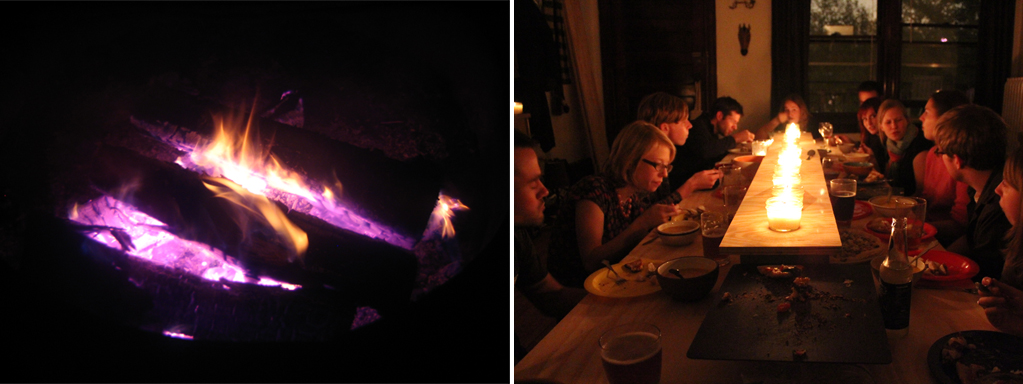
I mean, there aren't any other options.  Headlamps are the original task lighting.  The fire or lamp on a picnic table becomes the gathering place because it is the only place people can see (and its warm).  Its harder to move around when the whole area (or house) isn't lit up.  You walk to the bathroom, you gotta take a candle (or a flashlight).  Areas with the most lighting (like our table with a bunch of candles on it) automatically become the places people go to. 


4_Water is precious

Whether it is because you're waiting for it to rain or just haven't filtered enough water, water scarcity is a real issue in both camping and trying to live within your water 'budget'.  Camping in the frozen meadows below Grand Teton where the water is either frozen or ICE cold is a real test of how badly you need/want it and an excellent exercise in conservation.  Camping taught me how to do dishes in a no-oil world.  Use leftover boiling water from cooking for hot wash water. Pour your rinse water and wash water into two basins (or use the biggest two pots that are dirty).  Do cleanest dishes first. No running water needed.  Why do we abandon these habits when we go back to our homes with running water?


5_Connection with the elements

You havn't truly expereinced snow until you have slept in it.  And on it.  And under it.  I'm not trying to promote this in any way, it was actually kind of miserable, but gave me a totally different perspective of the kind of weather we have here.  We've done a great job at protecting and isolating ourselves from the elements.  After all, that's how we survived.  However, the more isolated we become, the greater the sense of unfamiliarity and even fear comes from being out in the elements.  Winter biking is a good example of this.  There aren't many mornings that I look out the window and get excited to jump on my bike and avoid snow chunks.  Once I am out there riding however, I realize how worked up I got about something that really isn't that bad.


7_You dress for the weather

Dressing comfortably and warmly for biking in freezing temperatures takes priority over looking nice.  These are my sisters on a winter camping trip in northern MN, clearly, the same deal ;)

6_Cannot create any waste

When we go camping we make NO waste, we EAT our toilet paper.  Well, maybe not.  Regardless, it is easy to be aware of how much waste you are creating when you are on a backpacking trip and have to carry it with you the rest of the trip.  Having to collect all the waste I create (even after eliminating as much waste as possible) has been a reality check for me (especially now that I have almost 90 days worth).  We've gotten really good at packing food and avoiding packaging in these situation.  There is also more motivation to avoid dumping stuff when in a pristine wilderness.  However,  it doesn't matter whether you throw that candy bar wrapper down a glacier or in an urban street, its eventually going to end up in the same place.  Paying attention to some of the ways I found to reduce waste on backpacking trips was a good start for me when I started this project: Refill your water bottle, avoid individually wrapped items, and buy in bulk using reusable jars. Pack it in pack it out.  Or in the no oil case-don't make it at all. 

An interesting exercise would be to carry around all the waste you create in a day.  At the end of the day, take an inventory of what was; organics, recyclables and trash.  If you eliminate some of the waste you create, try to find an alternative.  For example, ask if a restaurant can put your take-out in a container that you bring.

Monday, November 15, 2010

DAY 87_SNOW BIKES

9 November 2010

The time has come, snow is here.  What was predicted to be a few inches that melts on the ground turned into about 3 of snow that definitely isn't going anywhere, complete with a Snow Emergency Day.  While it is nice not to be driving around in the craziness of the first snow (there was something like 1000 accidents), I'm not sure biking is a whole lot safer (although definitely faster) in these conditions. 


snow bike!


more bikes in the snow

The City of Minneapolis has a page on their website specifically dedicated to winter biking
http://www.ci.minneapolis.mn.us/bicycles/WinterBikingTips.asp  What may surprise summer bikers is that 50 of the 60 miles of bike trails throughout the city get plowed just like city streets.  According to some friends that are hardcore winter bikers, the bike trails are usually the first to get plowed.  As it should be :)

The last two winter's I've lived in this ice-box of a city before this project I would bike until the end of October, and have never felt the need to tempt fate on a bicycle when it's icy and freezing outside.  However, the more I meet people who bike almost all year round, the more it seems like a possibility even in Minnesota (if you have the right equipment and clothes). Census data shows 4,800 residents of Minneapolis regularly commute to work on a bicycle. The number for the entire metro is 9,700 bikers. A local group called Transit for Livable Communities estimates one-third of those biking enthusiasts continue commuting to work during the winter.

A couple of bullet points from Shaun Murphy of the Minneapolis Bicycle and Pedestrian Programs: -- Minneapolis has 4,800 residents (2.5% of all workers) who regularly commute to work by bicycle, while the entire metro has 9,700 bike commuters (0.8% of all workers). So 50% of the regular bike commuters live in Minneapolis. [Source: Census data] -- Don Pflaum (City Bicycle Coordinator) estimates that about 15,000 bicyclers are seen each day during the warmer months in Minneapolis. [Source: Minneapolis Public Works estimate]

Here is a funny video of winter bikers:
http://www.startribune.com/video/12962607.html

http://www.icebike.org/ represents bikers all over the country who bike through the winter.  Who are these people? In their own words:

"Most of us are just ordinary folks, who get this addiction to bicycles that simply will not live within the bounds of a summer.  Others just don't want to spend the cash for a car and all the costs that come with motor vehicles.  Some of us have serious personal commitments to being car-free, others have temporary problems of liquidity, and others of us just like cycling way more than any rational person should."

Cheers winter bikers, I'll join you for at least the next week.

I"ll leave you with this warm SF critical mass vid: http://www.youtube.com/watch?v=NSmmz4vL74o


*Minneapolis bikers:
Use 311. If you see a bicycle-related problem which involves plowing, shoveling, signing, or another traffic concern, call 311. The City relies on the public to flag problems. If you live outside of Minneapolis, call 612-673-3000   A Minneapolis bikeway maintenance responsibility list is available for more direct call routing.