This era in history may be remembered as the "Peak Age", a brief time when nearly all materials used to power and create our society reach the maximum extraction and production potential. Past this point, all of these resources become increasingly difficult to extract until they are no longer economically viable resources to be using. There are hundreds of examples of resources, currently embedded in our industrial society, which have reached their peak in the 50 years surrounding 2010, but the one which will most impact our society is petroleum.

The goal of living for 100 days without oil is to understand the extent of our dependance on oil in American society today. Specifically, how it will affect my life, as a 25 year-oil living in Minneapolis, MN. By using myself as a metric I can take a close and conscious look at where oil dependance occurs in all aspects of our daily lives : How we transport ourselves from one place to another, what we eat, how much waste we create, how water is cleaned and transported, where oil is used as; an energy resource, in conventional medicine and for hygiene and how oil affects how we entertain ourselves and communicate with others. By demonstrating how someone would be forced to live without using any oil resources, outlining both what the sacrifices will be as well as the benefits, we can can identify the many systems which will have to be re-designed in a world without cheap oil, and explore a new way of living in which we live in an energy balance.


(At the bottom of this page is a link to my version of a flow diagram of 'Where Petroleum Exists in Our Daily Lives' (using information from the Energy Information Administration-Annual Energy Review 2008 fig 5.0 Petroleum flow) click and zoom to enlarge)


Wednesday, August 18, 2010

DAY 4_PLANTS ARE SPROUTING!

18 August 2010

miles biked- 12
water used- 5.95 gallons (9.05 surplus)


day 4 seed flat
This morning I woke up to find my seeds are already sprouting!  After only 4 days!  So far, I see basil, tomatillo, edamame and cucumber sprouts.  Throughout the day, the spouts were literally growing before my eyes!  There is hope.

basil babies!
On the topic of food, I am fairly certain I live in the PERFECT location to be doing this project. I live within yelling distance of two great food resources: three blocks from the Wedge Grocery Co-op http://www.wedge.coop/ and 1 block away from Eco-Politan http://www.ecopolitan.com//  (raw foods).  I was able to meet with Marcos Lopez-Carlson at the Wedge before starting this project and he helped me outline what foods would be available and meet my criteria.  Marcos explained that I was lucky to be doing this project in August because almost everything which grows locally can be found in August at farmer's markets and at the Wedge.  I made a list today of what I saw at the Wedge, it became clear that I need to find out when the END of the growing season for many of these foods is, to avoid a total and unexpected dry out of food supply. 
cucumber baby!
baby tomotillos!

Here is what I found today that was local and organic:

_Bell Peppers
_Cucumbers
_Broccoli
_Cabbage
_Gypsy peppers
_Chard
_Yellow squash
_Zucchini
_Portabella Mush
_Edamame
_Maybe Syrup
_lots of greens
_Apples
_really expensive blueberries

BULK ITEMS:
_lots of variety of bread flours
_sunflower seeds
_rye grain
_hulled spelt kernels
_hard wheat berries
_cornmeal
_flour
_rolled rye
_oats

Basically the only bulk items which are local are grains and oats.  To be honest, I don't even know where to start with most of the grains. I guess I should start making bread. The company which supplies most of the grains is Whole Grain Milling.

http://www.wholegrainmilling.net/index.html

While this company grows some of their products locally: Oats, Hi Lysine Corn, Buckwheat, Yellow and White Popcorn, Spelt and Soybeans, the rest arrives as raw ingredients which are processed locally and distributed.  Because the concern for most people who are motivated to buy local products is to support the local economy, the Wedge's definition of 'local' reflects that.  Any company which receives raw ingredients and processes them locally can be called 'local'.  This means that even companies like Peace Coffee are defined as local.  Peace Coffee is likely the most environmentally responsible choice for coffee's in the Twin CIties because they receive green beans and do all the processing and packaging locally, meaning the product does not have to be shipped around the country to various processing and packaging plants. However, in the context of my project (in which local means minimizing transportation as much as possible) the definition doesn't necessarily apply.  This means that I need to look into each company and find out where they are sourcing their product from.  Fortunately, this is made really easy with the Wedge's website, it is amazing and totally great how transparent they have made the information about where food comes from.  

WASTE:
My compost bin is molding, I'm going to guess this is a normal thing to be happening?  Because the food is rotting to turn into compost?  I shake the container up everyday and add some newspaper shreds, any advice on this?

ELECTRICITY:
Still working out my electricity budget, mostly because I got an answer that I can't accept haha.  I spoke with Jamie Borell at Innovative Power System's in St.Paul and based on my 1790 sq ft roof he had the following advice:

"Ballpark, cocktail napkin-drawn numbers:


You can fit 6kW on the roof or (30) 200-watt solar modules, producing 600kWh/ month or 7,200kWh/ year. This solar electricity offsets 900 pounds of CO2 per month or 10,800 pounds of CO2/ year and is the equivalent of planting 720 trees"

If I'm doing the math right, it sounds like 20 kWh a day total, divided by 6 residents is 3.33 kWh/day as an energy budget.

To give you an idea of what the breakdown of electrical use I have recorded so far is:

Daily these items use:
Grow Light - 175 watts/hr (8 hours a day) = 1400 watts or 1.4 kWh
Refrigerator - 68 watts/hr (24 hours a day) = 1634.4 watts or 1.634 kWh
Computer - 27 watts/hr (8 hours a day) = 216 watts or .216 kWh

As you can see, I already log a total of 3.25 kWh/day using only the essential things.  I haven't turned on a light in four days (except for the occasional forgetful light switching) and haven't been using my stereo or TV.  I have yet to calculate the energy used from my electric stove (which is a lot), and heating is obviously not accounted for yet.  So...um... uh oh.

me in the dark :/
I haven't quite adapted to the darkness thing yet, and I have to admit that I have been using my headlamp to find things.  I wonder how hard it would be to make an solar powered LED headlamp.... Candles are difficult and annoying to carry around.  I can waste A LOT of time trying to do things without ample lighting.  Luckily, when using my computer I don't need any extra light, so my schedule has shifted somewhat to doing all the tasks I need light for during the day and working more on my computer at night.  A friend had a suggestion that I change my schedule to wake up earlier when the sun comes up to maximize the amount of daylight I have.  I am surprised every morning how much easier it is to do everything with LIGHT.  Note to self: do the dishes before it gets dark.  Oh my gosh, the things we don't appreciate.  I am looking around for any place locally that sells soy wax (suggestions?)  I can't make regular candles (paraffin wax) because paraffin is a by-product of crude oil.  Soy wax candles are supposed to burn cleaner (clearly) and last longer, we shall see...

DAY 3_WATER + BREAKING OLD HABITS

17 August 2010

miles biked - 26
water - 7.5125 gallons used (7.4875 surplus)

So....I've been taking some pretty primitive showers lately and needed some water conservation advice, luckily, I had some excellent resources for conserving water yesterday in Graceville.  The couple who was the driving force behind initiating the greenhouse project (Bill and Carol Sutkus) lived for 21 years on a farm in NY without running water.  They wanted to raise their children 'off the land' connecting them to where our resources come from.  Living this long off the water grid eliminated any "need" they had for running water, and their family found ways to maintain their quality of life with the water they could carry from their well.  They told me they would carry a 10 gallon bucket about 3 times a day from the well and pour it into a large open cistern inside the house.  Whenever water was needed, it was scooped out with a cup or large ladle into whatever container was needed. 

Another resource was one of my committee members, Virajita Singh.  She grew up in Mumbai where water conservation was a part of almost everyone's culture.  The tradition, and the way she grew up was to bucket shower, and she has raised her two boys to bucket shower as well.  Virajita and her son Madhav explained to me that even though they have a shower in their house they still bucket shower because that is their habit.  They use about a 5 gallon bucket (which stays in the bathtub) and fill it with tap water which they then use a cup to dump over their heads to shower.  I asked them how you shower with one hand, and Madhav says "Its very easy!" 

However, its tough to break habits. Every morning a fill my rain barrel up with my 15 gallon "water quota".  Every time I need water for something I fill a certain container with the amount of water needed (record it) and carry it to wherever I am using it.  However, I have found myself turning on the tap ALL THE TIME without realizing it.  Usually, at some point using the water I notice that I have the tap on instead of using water from the rain barrel.  Like everywhere in the world, our spaces reflect our use of resources, for water-its in the bathroom. A typical American bathroom evolved out of having running tap water; we have a space for the toilet, a tap for the sink and two taps for the shower and tub faucets.  As soon as I have stopped using running water I've realize how inefficient the space really is to bring in water in different containers.  I have to carry my gallon bucket into the shower, bring another bucket and place it near the sink to wash my hands.  I've gotten in the habit of doing all my washing in the tub because it is the biggest space to put a bucket.  I stand in the tub with clothes on and wash my face at night, I stand in the tub to wash my hands.  Ideally, I think the whole bathroom would be tiled with a drain near the center, allowing containers of water to be placed in certain places and then dumped on the floor. 

Another interesting thing to consider is that 3.25 billion people in the world live without running water.  Water vessels and containers for carrying, drinking and storing are part of thousands of different cultures around the world.  A container that the Eames studied was the Indian "lota".

Charles Eames was fascinated by the Lota and considered it significant because it has become, over its evolution, exactly right. The design of the lota addresses the need of retrieving, carrying, storing, and pouring water. In his The India Report, he expressed a great admiration for the Lota and had the following to say about its design:


“ Of all the objects we have seen and admired during our visit to India, the Lota, that simple vessel of everyday use, stands out as perhaps the greatest, the most beautiful. The village women have a process which, with the use of tamarind and ash, each day turns this brass into gold. But how would one go about designing a Lota? First one would have to shut out all preconceived ideas on the subject and then begin to consider factor after factor:

The optimum amount of liquid to be fetched, carried, poured and stored in a prescribed set of circumstances.

The size and strength and gender of the hands (if hands) that would manipulate it.

The way it is to be transported – head, hip, hand, basket or cart.

The balance, the center of gravity, when empty, when full, its balance when rotated for pouring.

The fluid dynamics of the problem not only when pouring but when filling and cleaning, and under the complicated motions of head carrying – slow and fast.

Its sculpture as it fits the palm of the hand, the curve of the hip.

Its sculpture as compliment to the rhythmic motion of walking or a static post at the well.

The relation of opening to volume in terms of storage uses – and objects other than liquid.

The size of the opening and inner contour in terms of cleaning.

The texture inside and out in terms of cleaning and feeling.

Heat transfer – can it be grasped if the liquid is hot?

How pleasant does it feel, eyes closed, eyes open?

How pleasant does it sound, when it strikes another vessel, is set down on ground or stone, empty or full – or being poured into?

What is the possible material?

What is its cost in terms of working?

What is its cost in terms of ultimate service?

What kind of an investment does the material provide as product, as salvage?

How will the material affect the contents, etc., etc.?

How will it look as the sun reflects off its surface?

How does it feel to possess it, to sell it, to give it ? "

(Eames' India Report. National Institute of Design, Ahmedabad, India. Retrieved on 2007-03-22.)


I tried to think of what container in American culture most resembles the lota:


This illustration shows what my "water infrastructure" is currently made up of:


Lastly I'd like to address I comment made to a friend that my project was "too extreme".  Maybe I need to clarify the intention of the project a little bit better.  I'm not jumping to the conclusion that people need to live this way or that people would live this way without oil.  It is fairly difficult to imagine how our world, and the intricate framework of connections that creates our way of life, would be affected and disrupted by the loss of our primary source of energy-oil.  Local sources will appear to help with many of the things that I will be doing on my own during this project, making things much easier.  There will be benefits and sacrifices in the course of the project, influencing my life positively and negatively.  The intention of the project is to explore and identify everywhere oil exists in our society, modify my life to avoid oil use as much as possible and create a hypothesis of what a post-cheap oil world might look like in my specific location of the country.   As the elimination of cheap oil is a crisis that I will face in my lifetime, I believe that its extremely important to identify what parts of our lives will be affected and begin redesigning the way we live to accommodate a dramatic shift in our lifestyles.
 
Over and out.

Tuesday, August 17, 2010

DAY 2_EXCEPTIONS and WITHDRAWLS

16 August 2010

miles biked - 0
miles drove - 190 :/

Trip to Graceville, MN to present High School Greenhouse proposal:

This summer I am a research assistant at the Center for Sustainable Building Research (CSBR).  One of the projects I've been working on is a proposed greenhouse attached to a high school in a small agricultural community in western MN-Graceville.  Today we were scheduled to present our final proposal to the school board and, consequently, had to travel the 190 miles out there.  After considering my options (driving-3.5 hours, biking-15 hrs 43 min, walking-2 days 9 hrs) we decided it was best to travel by car only the few times it was necessary for work :)  This brought up an interesting consideration, however, which was how the project will affect the lives of those surrounding me, especially my roommates.  I live with 2 roommates in a house.  While both of these fabulous ladies have expressed their interest in incorporating some of the things I'll be doing into their lives such as composting, I certainly can't expect them to be living exactly the way I am (creating no waste, using water from a rain barrel and never turning on the lights).  After talking to my committee about this issue we decided it was best to focus on the spaces in the house which I am personally occupying, meaning: If I walk into the kitchen which has someone in it, I won't be turning off the light, however, if I was in the space alone, I wouldn't have the light on.  In the same way, it is unrealistic (and not the point of the project) to refuse to eat food that doesn't meet my criteria at another person's house, and so on.  When making meals for other people at my house, I will be following all of my 'rules'.  Whenever possible I will be following the criteria I have outlined.  In a world without cheap oil, it is likely that telecommunications will be greatly improved and utilized much more frequently than now.  We've already begun to see a shift in telecommuting options, and it is a recognized step for businesses and universities to facilitate this type of communication to save energy/dollars their employees would otherwise use traveling. 

I want to share a little bit about the greenhouse project because the process of learning about the possibility of growing food year-round in Minnesota has inspired a lot of the food-related items of this thesis.  The Graceville community initiated the project after creating a community garden run by students a few years ago.  The need for fresh and inexpensive produce in these small rural communities is HUGE.  There is only one grocery store in Graceville and, ironically, even though it is an agricultural community, the store doesn't stock hardly any fresh produce.  Small grocers in these communities cannot compete with the supermarkets at Walmarts and other large, nationwide stores even though these stores are located hours away.  Because most residents need to travel the distance to the a larger town anyway at least once a week to get other supplies, they do their grocery shopping outside the community.  The small, community grocery store in Graceville, consequently, has a lot of trouble staying in business.  They actually refer customers (with permission of the school) to pick fresh herbs out of the community garden in an effort to supply their residents with healthy, fresh vegetables.  With this issue in mind, Graceville's vision is to build a greenhouse on the high school which can supplement the school's lunch program with fresh, local produce, while educating students (who are often quite disconnected from growing food to EAT rather than sell) where food comes from and what goes into a healthy diet. 

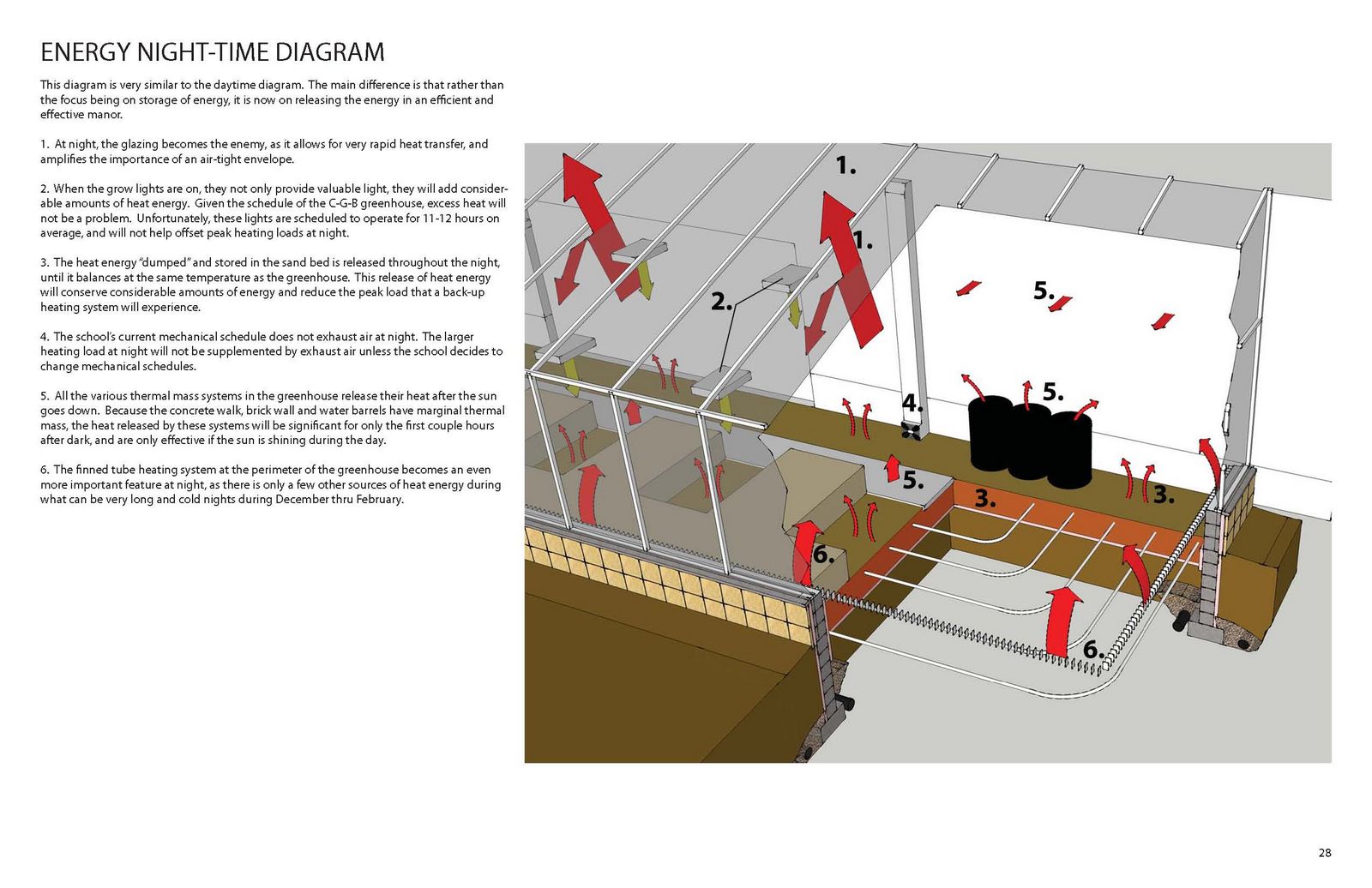
The team working on the greenhouse was made up of; Virajita Singh (Senior Research Fellow at CSBR), Jess Roberts (Energy Consultant-Designed Solutions LLC), and myself.  Our proposal was a 44'x16 ft greenhouse on the south facade of the building.  316 sq ft of growing space was created in 2' raised beds (beds allow for maximum production as opposed to pots), and an additional 116 sq ft of growing space in 1'x4' hanging planters above the beds.  Jess Roberts came up with three scenarios for heating options.  They included a combination of the following: (1) Solar Thermal,  (2) Diverting hot air which is currently being exhausted out of the building into the greenhouse (this air is rich in carbon which is good for plant growth), (3) geothermal system, and (4) a biomass gasification system which could be a possible collaboration with the University of Minnesota-Morris.  The profile of the greenhouse is maximized to receive the most solar heat and light gain at the shortest and coldest time of the year-the winter solstice (Dec 21).  The angle on the front is 68 degrees which is perpendicular to the sun angle at noon on Dec 21st allowing for the least loss of light and heat due to the reflection of the surface. 

Below are images and drawings of the proposed greenhouse: (clicking images opens a new larger window)


revised profile to maximize solar heat and light gain during the winter solstice


On another note, I woke up feel really drained this morning, and, of course, couldn't have coffee either.  Virajita, who has read quite a bit about the transition into a raw-foods diet (which is similar to what I'm doing), mentioned that when you go from eating processed foods and lots of sugars (a typical American diet :( ) to one which is only organic vegetables your body goes through a week or so of a kind of detoxing.  Because I don't drink coffee everyday and already was eating only a limited the amount of 'boxed' foods, I was surprised to be feeling so drained.  While the next few days without caffeine and processed food will probably be tough, I am fueling my body with much more direct nutrients now than before (I'll expand on this later), and hopefully will be feeling totally awesome in a week or so, time will tell!

Sunday, August 15, 2010

DAY 1

DAY 1

15 AUGUST 2010

miles biked - 12
water used -  12.2625 gallons (2.7375 surplus)
3.25 kWh used (without electric stove included)

“We must face the prospect of changing of basic ways of living. This change will either be made on our own initiative in a planned way, or forced on us with chaos and suffering by the inexorable laws of nature.”

(Jimmy Carter)

FOOD:

First day without oil and I've already googled "where does chocolate grow".  oh man.
 
While I have a few good ideas of meals to make for myself, after only one day I'm already starting to see how limiting buying only locally is.  That is, compared to the HUGELY VAST array of foods available for our consumption from all over the world.  I have come to take advantage and be dependant on foods that 100 years ago were not even a distant thought for native Minnesotans.  Coffee, spices, teas, chocolates, tropical fruits, olive oil, avocados, citrus, the list goes on. 

For breakfast this morning I made oatmeal with the last bunch of blueberries of the season.  Oatmeal is locally grown, bought in bulk at my grocery co-op.  Luckily, I live 3 blocks away from this grocery store, which is my only resource for food besides the farmer's markets and some scattered local/organic produce found at other high-end grocery stores.  I also came to realize that possibly my only option for sugar (besides sugar found in fruit) is honey.  I made the oatmeal with milk in a returnable glass jar (Cedar Summit), and added blueberries.  I'm going to need to research how long local grains are stocked in bulk at the co-op and maybe stock-up accordingly so I don't run out of all local grains.  A also made a meal of vegetables I found at the St. Paul farmer's market yesterday.  The St. Paul market is all local vendors, though not everyone is organic so I have to ask.  I mixed together yukon gold potatoes, green bush beans, garlic, cilantro and sauteed it all in a local/organic sunflower oil.  Sunflower oil is my replacement for olive oil as most of that is imported, and, sadly, none grown locally. 


The other obstacle I will run into is although there are a wide variety of locally grown vegetables in Minnesota, our growing season is less than 5 months.  This means that unless I can, dry or freeze foods there will come a point where nothing local is available.  It is too humid to dry many foods in Minnesota, especially meats, canning takes a huge amount of energy and freezing may also be out of my "electricity budget". 

To remedy this possible dry-out of available foods I've started seeds to grow vegetables in my living room.  I have a grow table 3'x8' which sits in front of a south-facing window.  The light coming in from the window is not significant so it has to be supplemented with grow lights .  I have a fluorescent grow light which is 20,000 lumens (about 1800 foot candles).  While this may seem like a lot, the comparative light that vegetables get outside is 50,000 foot candles.  The most efficient grow lights are metal halide and high pressure sodium (HPS), however, they use an ENORMOUS amount of energy, and would overtake my electricity quota.  With advising from Interior Gardens (an excellent interior growing store in NE) I was pointed towards fluorescent lights.  It is questionable whether these lights will be bright enough to grow certain vegetables, but the greens and herbs should get sufficient light. 


I spent last night starting my seeds.  To avoid using lots of plastic seed trays I am making soil blocks from a "soil blocker" mold.  I started 50 seedlings, an assortment of the following:
_Basil
_Cilantro
_Lemon Balm
_Romaine Lettuce
_Arugula
_Rosemary
_Green Beans
_Tomatoes
_Cucumbers
_Jalapenos
_Collard Greens
_Spinach
_Tomatillos
_Soybeans
_Onion

The germination period on the vegetables and herbs is 5-8 days and the greens take 10-14 days.  Hopefully in a week or so I'll see some sprouts!

WASTE:

On another note, I've been composting for 2 days now, a last oil-world meal cooked last night resulted in almost a gallon of compost, which means I may end up with a lot.  My homemade composter is two rubber tubs stacked on top of each other, the top tub is shorter than the bottom one and has small holes drilled in the bottom to allow for drainage into the "catchment" tub beneath it.  The tub is covered with a lid. I'm mixing in newspaper with the compost and debating getting worms.  It sounds like worms create better quality compost for use in soil and compost faster...advice is welcome.

ELECTRICITY:

I've spent a part of the day calculating energy usage for various appliances around the house.  I'm using a "Kill-A-Watt" meter to count up kWh over time, which I can then calculate watts/hr.  In a spreadsheet I'm keeping, I'll be keeping track of all electrical use to make sure I don't go beyond my hypothetical solar array limit (still to be determined).
_laptop computer 27 watts/hr of use
_large fridge 68 watts/hr (continuous)
_grow light 175 watts/hr (8 hrs a day)

The grow light is a huge energy suck, I'll also be calculating energy used by my electric stove, radio and lights around the house. I avoided using lights all day because I'm unsure what my quota is at this point.

HEALTH + HYGIENE

Everything today has taken about 4 times as long as it typically does.  Everything I did I had to think about how I was going to go about it.  We confirmed the square footage of my house last night as 1791 sq ft, thus harvesting 120 gallons a day (average rainfall) (see calculation on first post).  This leaves me with exactly 15 gallons a day to use.  I filled a 15 gallon rain barrel this morning which has a pump.  This is a good way to store all my day's water but makes it difficult to use for various purposes (hand washing in bathroom, showering)  This morning I took my first 1 gallon bucket shower and had plenty to spare.  I imagine most day's I will be able to use 1 gallon for showering and at least once or twice a week use about 5.  Water was cold.  Below is a quick illustration of my current and post showering situations.  Most conventional bath products are made with at least one of the following: Petroleum based: fragrances, colors, preservatives.  They are all packaged in plastic.  Even my washing tool (loofah) itself is plastic.  My new showering method includes locally made soap (with no petroleum additives) I can buy this soap (Bryn Mawr) without any packaging at my co-op (The Wedge).  Today I had to use my old loofah but eventually I'll have a natural sponge (pictured is my roommate karli's -don't worry, I didn't really use it)


I'll end this post with a tribute to a fabulous beverage.  One which has been there to support me in times of need, but, at least for the next 100 days, will no longer be a part of my life. 

Iced Latte, you will be missed.


Saturday, August 14, 2010

BEGIN....ANYWHERE

14 AUGUST 2010
LAST DAY OF OIL!

As a first post I'd like to outline the criteria for my Master of Science in Sustainable Design Thesis as well as the goals and context of the project.  A little background first: I'm an Architecture/Sustainable Design graduate student at the University of Minnesota.  This project is a bit of a follow-up of my Master of Architecture thesis last spring.  In that project, I explored what it would involve to live in a post-oil world in Phoenix, AZ (possibly one of the most oil-dependant cities in our nation).  I link to an intro video from that project is found here:

http://www.vimeo.com/8868577

I designed a prototypical 4-person dwelling unit for a Phoenix-without-oil, using the ancient native Hohokam people as an example of a society of scarcity (and thus a model for living in energy scarcity once more).  The project left me curious about what it would be like to live in a world without cheap oil in my own life.  By using myself as a research tool I can easily document all aspects of my life and how they might be affected in this not-to-distant world.  I'll be tracking my life in seven categories: Transportation, Food, Waste, Water, Electricity, Health/Hygiene, and Communication/Entertainment.  The ultimate direction of both projects is to identify the dramatic design changes which will take place in our society as oil become more expensive/depleted.


DATES: 100 Days (August 15-November 22)

COMMITTEE: Thesis Committee: Thomas Fisher (chair), Billy Weber (advisor), Virajita Singh (advisor)

GOALS:

_Understand the extent of our dependence on oil in American society today (2010, Minneapolis, MN)
_Identify where oil occurs in our everyday life
_Demonstrate a quality of life which can be achieved in the post-oil age, outlining both what the sacrifices will be as well as the benefits

CONTEXT:

This era in history may be remembered as the “Peak Age”, a brief time when nearly all materials used to power and create our society reach the maximum extraction and production potential. Past this point, all of these resources become increasingly difficult to extract until they are no longer economically viable resources. There are hundreds of examples of resources which are currently embedded in our industrial society which will or have reached their peak in the 50 years surrounding 2010: Minerals of uranium, aluminum, and lastly, possibly most alarmingly: Energy resources of oil and natural gas.

Oil is estimated to have peaked in 1970 in the United States and in 2007 for worldwide extraction. Our use of oil in the United States and in most areas of the developed world is an addiction that has been evolving for 150 years. Today, 40% of our total energy nationwide comes from oil. Our systems of water, energy, food distribution and production have become decentralized with the availability of a cheap source of energy to build necessary infrastructure. Oil-fueled manufacturing processes have allowed us to become a truly disposable society throwing away 3.5 pounds of trash/person/day. With increased transportation availability, an average meal comes from 1,500 miles away. The building materials in our homes tell a similar story. Construction materials come from all over the nation and even the world. A typical home in Phoenix is built with the same materials and methods of construction as one in Oregon or Minnesota.

A 2% reduction in oil use beginning at peak worldwide oil production (2007) leads to a world without oil occurring around the year 2050. Although the transition will likely be slow, as we are already seeing the effects of oil depletion with rising fuel costs, there will undoubtedly be an inevitable change in our basic ways of living.

CRITERIA:

TRANSPORTATION
_only non-petroleum driven transportation (bicycle/walking/bio diesel) no buses, taxi's, cars, planes

FOOD
_all organic
_all local
_no synthetic (oil-based): fertilizers, artificial flavors, artificial colors, preservatives
_cannot be packaged in anything which can't be composted (no plastic)
_cannot be stored in plastic containers

WASTE
_create no waste (all items bought in containers must be reused) all waste must be compostable

WATER
_can only use the amount of water which falls on the roof where I live (divided equally among residents)

Calculation:
Annual Minneapolis rainfall of 29.3”/year

144 inches3/231 (in3 in a gallon)=0.623 gallons in a sq ft

29.3 inches=18.3162 gallons per sq ft of roof/yr

18.3162 gallons/sq ft/yr divided by 365 days =0.05018 average gallons/day

0.05018 x 1791 (sq footage of my house) =89.87 average total gallons captured on roof

89.87 gallons /6 residents (3 upper level, 3 lower level) =
14.98 gallons/day (my share)


ELECTRICITY
_a hypothetical solar array located on my roof produces ___kWh of electricity per day. I can only use this amount of electricity, tracking all of my electrical usage each day to see that I don't exceed this quota.

HEALTH+HYGIENE
_many cleaning and beauty products as well as conventional medicines have petroleum products in them, I can only use products which don't have any petroleum ingredients, making many of my own products.

COMMUNICATION + ENTERTAINMENT

I appreciate your time reading this blog and following the project, please leave comments and suggestions, the more involvement the better!