This era in history may be remembered as the "Peak Age", a brief time when nearly all materials used to power and create our society reach the maximum extraction and production potential. Past this point, all of these resources become increasingly difficult to extract until they are no longer economically viable resources to be using. There are hundreds of examples of resources, currently embedded in our industrial society, which have reached their peak in the 50 years surrounding 2010, but the one which will most impact our society is petroleum.

The goal of living for 100 days without oil is to understand the extent of our dependance on oil in American society today. Specifically, how it will affect my life, as a 25 year-oil living in Minneapolis, MN. By using myself as a metric I can take a close and conscious look at where oil dependance occurs in all aspects of our daily lives : How we transport ourselves from one place to another, what we eat, how much waste we create, how water is cleaned and transported, where oil is used as; an energy resource, in conventional medicine and for hygiene and how oil affects how we entertain ourselves and communicate with others. By demonstrating how someone would be forced to live without using any oil resources, outlining both what the sacrifices will be as well as the benefits, we can can identify the many systems which will have to be re-designed in a world without cheap oil, and explore a new way of living in which we live in an energy balance.


(At the bottom of this page is a link to my version of a flow diagram of 'Where Petroleum Exists in Our Daily Lives' (using information from the Energy Information Administration-Annual Energy Review 2008 fig 5.0 Petroleum flow) click and zoom to enlarge)


Sunday, September 5, 2010

DAY 20_GREENS

3 September 2010

As I mentioned before, I'm focusing more on growing greens on the grow table instead of as many vegetables.  This is for a couple reasons:

_The green's season in Minnesota is almost over-no greens available once it gets cold
_There isn't any great way to store greens, canning, freezing or drying
_Greens can be grown as "microgreens" which can be harvested in less than 30 days.  These greens are basically harvested when they are 4-5 inches tall and are contain the most nutrients as young plants.
_They take less time because they don't need to be transplanted.  They can grow with a shallow root depth (in seed flats right now) and can grow fairly close together, maximizing the amount of food I can grow under the one grow light I have.

I started my greens about 4 days ago and am already seeing a lot of sprouts!  I planted half of the flat with Collard Greens and half the flat with Romaine Lettuce.  I'm planning on planting a new flat every week for 3 weeks, hopefully this will give me a steady flow of greens for the rest of the project...

Left is a picture of the sprouts, they are actually getting too big now, gotta eat them!

So the question with all this is, how am I going to eat so many greens?  I'm trying out the green smoothie method, here is my first attempt:
_1 nectarine
_1 spice plum
_1/2 bunch of dino kale (about 1 cup chopped and packed
_small bunch of parsley
_1 cup water

Not bad, the texture is weird because you have to chew a little bit after each sip...

I think this will be a good way to get the nutrients I need from vegetables that are out of season. 

Lastly, I wanted to show a picture of my kitchen cupboards.  I've collected a large variety of bulk foods at this point: bread flours, nuts, maple sugar, oats, yeast, baking soda, salt, cornstarch.  The cabinet has my roommate's food on the left half and my food on the right half.  Top shelf I keep all my empty containers for shopping and the other two shelves have all my containers of bulk, local, organic foods and vegetables/garlic....No more boxes!

When I was filling up mason jars full of bulk foods the other today at the co-op a noticed a lady kept looking at me.  Finally she came over and exclaimed excitedly "that's such a good idea! you don't have to use any bags!"  I told her that, yeah it was really nice not to have to collect all the plastic bulk bags (which there isn't much other use for) and that bringing containers was really easy, all you had to do was weigh the container first.  She was really excited about this because apparently she had a lot of containers she didn't know what to do with and told me "I just hate all these bags!"  Talking to her made me realize how much of the bag use is purely out of habit.  I started thinking of all the things I would put in bags until starting this project and I couldn't use them anymore: greens, small vegetables.....Once you get in the habit of bringing containers it starts to seem sort of bizarre that you ever used bags in the first place (especially for individual produce items), but after only 3 weeks of doing this I can hardly remember how I shopped before...weird. 


Friday, September 3, 2010

DAY 19_MY OTHER BIKE IS A HUMMER

2 September 2010

While all of the food, drink and health products I'm buying are local, most of them are coming from the co-op I live by or the farmer's market, meaning they had to be transported (even the short distance) to each of these places.  A friend pointed out that the more products I could actually buy AT THE SOURCE the more I would have an understanding of what goes into making those things.  Even things that are made "locally" often have many other added ingredients which come from far away.  This is an excellent point, and I figured I'd start with one product I was particularly suspicious about ingredient sourcing-beer.  :)


Our big destination today was a tour at the Summit Brewery.  Summit gives tours every Tues and Thurs at 1 and on Saturdays (but you have to reserve).  The brewery is located along the bend in the river between Minneapolis and St. Paul-an 11.6 mile bike ride from Uptown.  The ride was really nice because we could take the Greenway which connects to the Mississippi River Pkwy the whole way there.  Pulling up on our bikes in this industrial area we were doubting we would find bike racks and were about to go find a street pole when we found racks right next to the front door!  Yeah! The best part about biking is you almost always get the best parking spot available. 

It became clear when they were explaining the ingredients that go into their beers that even "local" beers are not necessarily local.  Obviously all the brewing happens here but the ingredients could really be coming from anywhere.  For example, they are doing an series of beers called "Unchained", the beer in this series this year is a Belgian Style Golden Ale.  In order to make an authentic tasting Belgian beer they really have to get ingredients (malt, hops) from Belgium.  Many of their other beers are likely quite a bit more local than that one.  The original Summit Extra Pale Ale is their flagship beer (and the best) and all ingredients in that beer are at least grown in the US, if not the Midwest.  Stick to the local stuff Summit, you do it better that way :) 
The tour included seeing the huge fermenting room, bottling room and 3 free beers for everyone.  Seeing the bottling room left me with questions about if they reuse bottles like they do kegs.  I interrogated the tour guide as he was passing out drink tokens and he said he didn't know of any breweries in Minnesota that had a bottle-return program.  That Wisconsin breweries used to do this, but he wasn't sure even they did anymore.  It would make SO much sense to do something like this.  It would save money for the breweries, for the customers (either as a refund or in less cost from not having to buy more bottles).  Without even considering the energy intensive process of making hundreds of thousands of glass bottles every year, this seems like an obvious move breweries could make.  We were further disappointed to find that they didn't sell any growler-size beers anywhere.  Most breweries I've heard of let you buy growlers of beer and you can return the bottle or refill it when you are done for a refund.  Anyone know of breweries that do this in the Twin Cities?


Our next stop was Izzy's Ice Cream on Cleveland and Marshall.  Izzy's is great, a local company...but are their ingredients local?  We interrogated an unsuspecting worker who ended up knowing quite a bit about their ingredient sourcing.  It turns out they get the "base" for all of their ice creams from a place just across the river in Wis.  I forget the name of the town (started with an M....) but the majority of the ice cream is this base.  After that, they get ingredients that they can find locally as much as possible.  Both the workers there knew some of the sourcing for specific flavors which was great.  It is fairly easy to guess what flavors could be totally local after searching for local foods for 3 weeks (the berry flavors were safe for sure)  I got a maple nut with a little raspberry...The mistake I made, however, was I got a cup! Oh god! I totally forgot, everyone else got cones and it wasn't until we all sat down together that I realized my fatal flaw.  Waste.

The highlight of being at Izzy's however was a bumper sticker we spotted on an SUV that pulled up next to us.  "MY OTHER CAR IS A BIKE".  Wait. What? Your OTHER car?  Is a bike?  Is that supposed to be a good thing?  Is that any different than having a bumper sticker that says "I own a bike"?  I dunno, I don't get it.  Congratulations?  My other bike is a Hummer, or...um...whatever.

Total of 26.13 miles logged in 2 hours and 14 minutes round trip.  I've officially gone 200 miles in 19 days! 

To reward ourselves we decided to make a breakfast dinner.  On the menu:

_Waffles made with all local, organic ingredients, topped with pure maple syrup mixed with chopped walnuts.
_Hash browns with onions, garlic and butter
_Bacon from Beller Farms (Wedge)
_Winehaven Marechal Foch Red (Chisago Lakes Area)

This was only the second time I've had meat during this project so that was really exciting, super great meal. We cooked the entire meal by candlelight and the worms got the leftovers. Thanks for playing no-oil with me guys :)


DAY 18_IF ITS YELLOW LET IT MELLOW

1 September 2010

I'm realizing more and more that this project could have been done in phases.  It is really difficult to integrate a totally different way of living in all different aspects at once.  The result of trying EVERYTHING at once is that you focus on necessities.  Food has been my main focus I feel like up to this point, and finally, now that I am on week 3 of the project I feel like I've finally figured out how to eat a healthy diet from local foods (definitely more to learn, but at least I can feed myself :) ).

I've gotten back to figuring out my water situation more again.  One of the big challenges of getting all your water out of a rain barrel is it isn't running water.  This makes it harder to rinse things because there isn't the force of water coming down.  However, I got through a lot less water rinsing because I fill up a container with only the water I need.  A lot of my water habits lately are tried and true camping methods of: dong dishes and washing hands.  I use 1 gallon of water doing dishes usually.  I fill up one tub with 1/2 gallon of rinse water and another tub 1/2 gallon full of dish water.  By putting soap in the tub before I dump water in, the suds come from the force of the water getting dumped.  Dish soap is WAY more concentrated than I originally realized.  By only using a little dish soap and stirring up the water enough i can get a sudsy tub full of soap. 

With the permission of my roommates, I'm taking the "if its yellow let it mellow, if its brown flush it down" approach.  More people do this than I realized after talking with people about it.  Really though, we are peeing in drinking water, that's pretty obscene, so whatever can be done to save water in this case is important.  Another method I learned with my dad when I was about 6 from the book 100 Ways to Save the Planet, (haha my parents weren't trying to brainwash me AT ALL) was putting a milk container in the toilet container to displace water and use less with each flush.  The average toilet uses 1.6 gallons of water per flush.  I flush mostly twice a day so that is 3.2 gallons used on just flushing everyday.  Abby had a 1/2 gallon jug from apple cider and put it in the toilet container.  Instant low flow toilet!  I will now only use 1.1 gallons of water with each flush, we could put a larger jug (1 gallon) in there once we find one. 

Rinsing potatoes the other day I realized I could reuse the rinse water a few times.  I put my potatoes in a strainer over a tub and poured my rinse water over, then dumped it back into the bucket and poured again.  What I ended up with was a mixture of dirt and nutrients that washed off the potatoes which I thought maybe the plants would like, so they got potato water yesterday.  This way the water was really used 3 times and never wasted. 

While meeting my water budget has never been a problem in this project so far, the more efficiently I can use water the more liberally I can use it on other things (maybe a 2 gallon bucket shower every morning?)  Talking with Rich Strong at CSBR the other day brought up a good point that a goal of the project should be to demonstrate a quality of life that is equal to what we have now.  While everyone has a different interpretation of what "quality of life" means, by finding ways for people to use water without constantly worrying about its scarcity seems like a reasonable goal to me.  My water use has increased over the last 3 weeks.  The first week I was being really conservative about water and not necessarily using it very efficiently.  I had a day I only used 5 gallons of water.  By week 2 I was using a more comfortable amount of water and now on week three I'm beginning to find ways to use water 2-3 times and get more out of the water I'm using (allowing me to use even more water) but stay in my budget of about 12 gallons a day (leaving the other 3 gallons of water of surplus each day for cleaning on the weekend.)

(click image to enlarge)

Wednesday, September 1, 2010

DAY 17_BAKE FEST

31 August 2010

I spent a chunk of time today scouring a million recipe books looking for meals made up of local foods (or recipes that can be modified to be only local).  This is only half-fun because I have to look at all the pictures of foods that I can't eat (chocolate deserts, lemon-flavored everything...)  Mitch Omer of Hell's Kitchen (a local foods restaurant in downtown Minneapolis) has a recipe book which also tells the interesting story of his life.  I've also been looking through some Minnesota Traditional recipe books.    There are TONS of excellent sounding recipes for different breads, cheese dishes and potato dishes.  Most of these recipes include either butter or heavy cream. The conclusion I've come to is, basically we don't have a tradition of cooking real healthy meals in local Minnesota culture.  I'm guessing this is for a few reasons: the growing season only allows for fresh produce about half of the year, the produce that CAN be stored through the winter are starchy root vegetables such as potatoes and carrots.  The reality is, these foods don't have a lot of taste on their own, so the solution is often to soak it in butter or cream to make it more palatable.  I'm going to start with some of these traditional recipes and see how they can be modified to be more healthy and to add some of ingredients I am growing on my table-because excitedly things are finally growing! 

Last night I was having a crazy craving for fat and bread and hadn't made any bread this week.  I started out making hash browns for the first time.  I am always amazed at the things I never did before.  Hash browns are just about the easiest thing in the world to make, you grate a potato and fry it in butter and a little oil for like 7 min on one side and 4 on the other.  After that I hard boiled some eggs.  Then I was still hungry :) so I started making muffins (it was the first recipe in the bread section).  My recipe was the following:

1 3/4 cups all purpose flour (Whole Flour Milling)
1/3 cup maple sugar
2 tsp baking powder
1 egg
3/4 milk (Cedar Summit)
1/4 cup sunflower oil

I kept them pretty basic for now, and they were pretty good, not very sugary (maple sugar isn't quite as powerful tasting as cane)

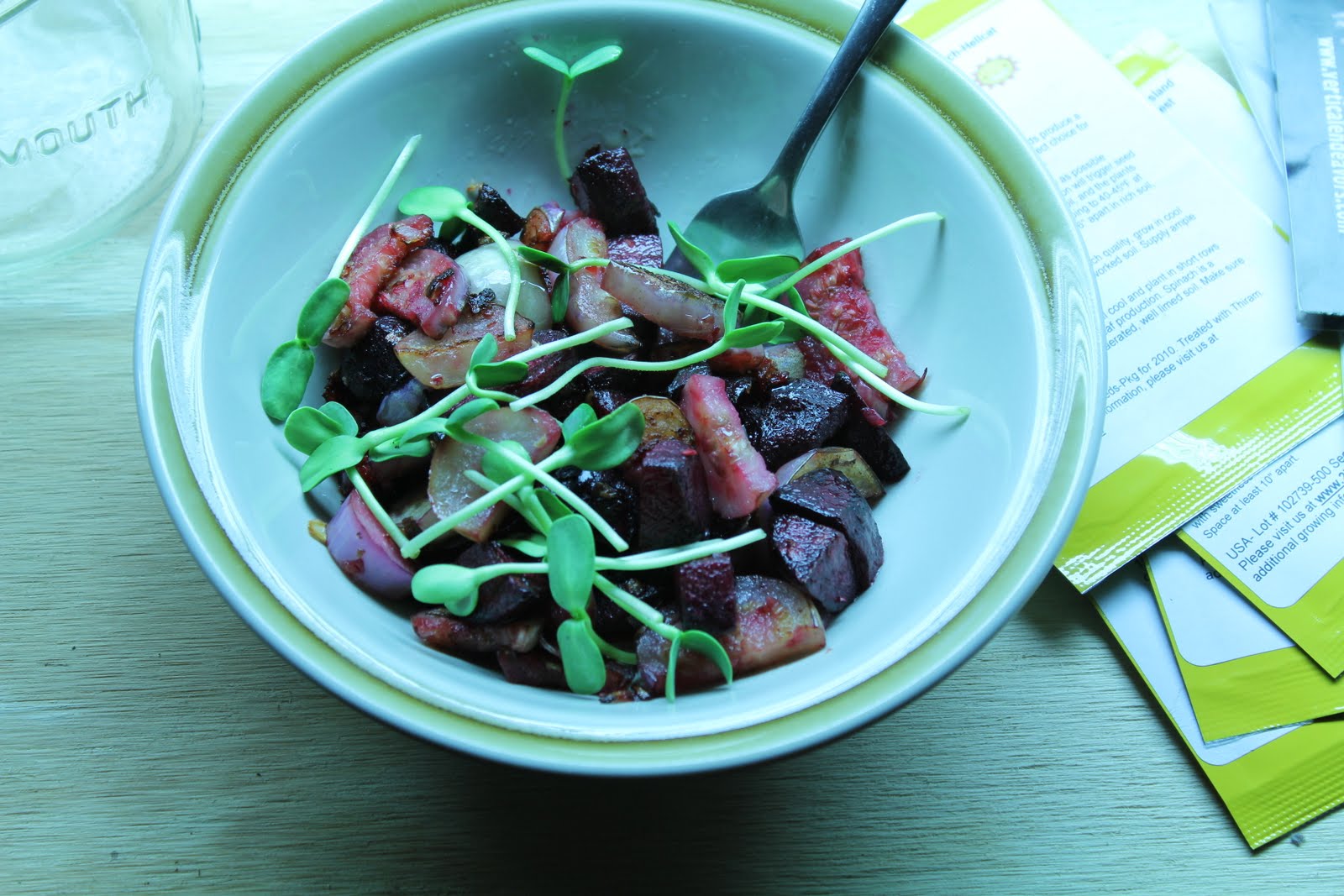
My sunflower sprouts are growing like crazy(more than an inch a day) some are already ready to harvest and the others will be done in a day or two.  I cut some off today and tried a new vegetable mix dish.  Beets and mini eggplant chopped and sauteed with shallots, hot peppers and sunflower oil.  I put the sprouts on top (uncooked) and it was EXCELLENT.  Super healthy and the sunflower sprouts add a lot of nutrition and protein.  

The other big thing today is I started growing micro greens.  Micro greens are my new plan for the grow table (at least while the other vegetables are still sprouting).  They are basically young greens (bigger than sprouts but smaller than a full plant).  You can plant them fairly close because they never get too big.  You cut them when they are about 4-5 inches tall.  Young greens contain a lot more nutrients because they are still absorbing a lot to grow quickly.  I planted one seed flat full of green seeds today.  Collard greens on one half and romaine on the other.  My plan is to plant a new batch every week so I have a rotation of greens which can be harvested weekly.  I am a little worried that it is still too hot for them, but I'll try to keep them in a cool place until they have germinated.  Good luck little greens! I'm counting on you!

DAY 16_GIVING OUR POWER AWAY

30 August 2010

I swear I'll stop talking about food soon and focus on other aspects of the project, but I've come into contact with so many amazing resources (mostly reading about raw foods) while researching the affect processed foods (enabled by oil) have on the human body.  Hands down the most interesting book I've read about this is Green for Life by Victoria Boutenko.   Raw foods books are an excellent resource for anyone interested in what kinds of nutrients are found in raw, whole foods, whether you are going to cook with them or not.  While raw food may become integrated into my diet more as I learn about how much energy is required to cook food, for now, it is just interesting to read how far we have detached ourselves from eating REAL foods in a typical American diet.  The more I have become aware of just how much stuff we put in our bodies that just isn't food (preservatives, synthetic colors and flavors...) the more shocked I am at how unhealthy my 'old' diet appears to me.  Its no wonder that even as medicine has advanced that people continue to get sicker and more 'uncurable' diseases become prevalent, a huge part of this is that we are simply not fueling our bodies with real nutrients. 

Victoria's Boutenko is a woman from Russia whose entire family (4 people) was diagnosed with a variety of long-term 'uncurable' diseases in the span of one year.  Doctors told each of them to take a variety of pills for the rest of their lives, and the chances of a recovery were slim to none. They didn't want to accept this as their only option and decided as a family to look really critically at their diets and try to find a way to improve their health through eating differently.  Victoria began to research the diets of chimpanzees.  By studying the diets of our closest relatives she could see how people are naturally meant to be eating, and use them as an example for their own diets.  What she found was this:


She discovered that chimps eat about 35% greens (not to be confused with starchy vegetables which have different nutritional properties).  After realizing this she tried to eat a lot more greens but found that she just didn't like greens enough to eat that many every day.  She began exploring options to integrate more greens into her diet and came up with the green smoothie concept.   Her whole family began drinking a quart to 2 quarts of this drink every day and within a few months, their symptoms all began to decrease.  Her husband began to grow back dark hair and they all felt energized and needed less sleep.  A link to an explanation of green smoothies on their website is here:

Because I am finding that greens are a really quick and easy thing to grow indoors I am excited to try the green smoothie idea to integrate a a better nutrition balance into my diet and see what the effects of this are. 

Ultimately, it is amazing to find how disconnected we have become to what is in our foods.  A large part of this disconnection has to do with having an energy resource that allowed for foods to be shipped from around the country and the world.  While it is great that we are able to get fresh produce (especially in Minnesota) during the winter when these things can't grow here).  As well as coffee, citrus, avocados, chocolate.  These are all foods which having an abundant petroleum energy-resource has enabled us to do.  However, the downside of this is in order to ship things long distances they need to be preserved in some way (or picked before they are ripe and full of nutrients).  It also allowed us to create all kinds of pre-made meals, and boxed foods which can last a LONG time.  The reason they last, however, is because of the synthetic ingredients added to the food.  Our bodies are not evolutionarily designed to digest these additives and it has affected our health in a negative way fairly dramatically. 

The most interesting part of Green for Life to me however, is a statement she makes in the introduction to the book:

"As we live our lives, trying new things and searching for true answers, we gain plenty of our own experiences.  Our knowledge becomes familiar and practical.  We fell rather confident in any life circumstance and particularly when we need to make urgent decisions.  Contrary to that, when all we have is a compilation of someone else's instructions, the best we can do is to hope an pray that the authors of such instructions were efficient tin acquiring their knowledge and honest in their intentions.  In other words we hope that someone else cares for us more than we care for our own selves. 

When we let other's observe and reason for us, in a sense, we consciously choose to stay blind and deaf.  We become compelled to follow someone elses's instructions, one after another, and perform actions which do not make much sense to us.  We submit to other's authority. We give our power away.

To observe is our birthright.  If we utilize our ability to observe, we can free ourselves from the labyrinth of confusions.  I believe that our own conscious observations are a thousand times more important than any rigid scientific claim." (page 3 Green for Life)


In a world where we have become so disconnected from where our food comes from and what is in it because it is more convienient, it is essential that we take it upon ourselves to understand these things for ourselves and make our own decisions about what is healthy based on how we FEEL not by other people telling us what is good for us. 

We are our own best teachers. 

Monday, August 30, 2010

DAY 15_EATING BIRDSEED

29 August 2010

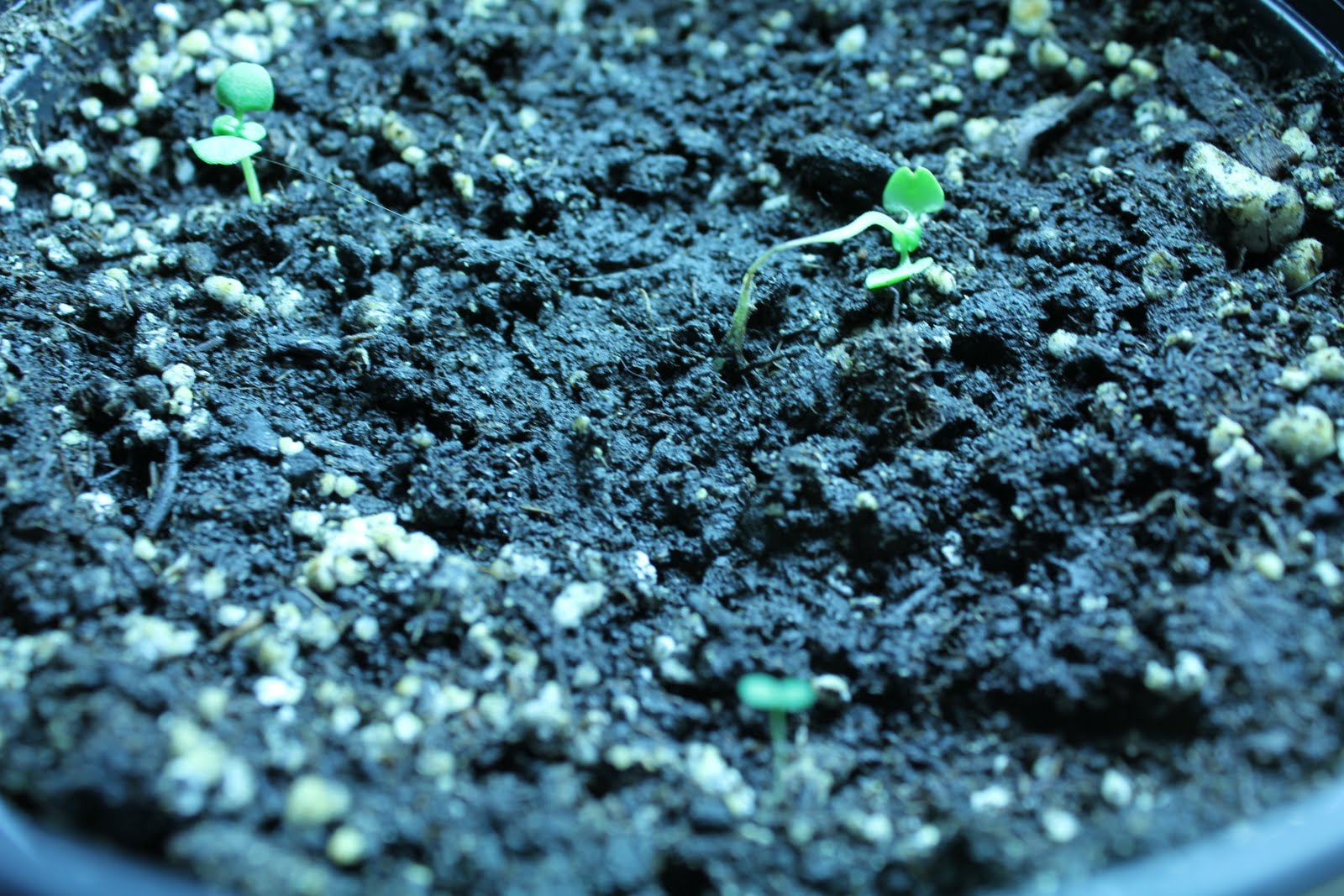
After some failed vegetable spouts and a rapid depletion of variety of foods available at farmer's markets already, I've decided to re-work my grow table plan a bit.  I have some vegetables coming up as sprouts still, but many were fried when it got too hot (and I left the lid on).  One of the problems I'm having is the sprouts look fine and I transplant them and they seem to die in the middle of the stem.  My basil is shown here, it literally just can't keep itself up anymore and flops over (stem in the middle is really thin now).  A project we studied while doing our greenhouse project this summer was a winter-CSA run out of a greenhouse in Milan, MN.  It is about 16'x22' and feeds 20 families, mostly growing microgreens, without any supplemental lighting and barely any heating.  What is interesting is they grow all the greens in rain gutters (only 4" deep).  They can have a continuous supply of nutrient rich microgreens (greens harvested after only a few weeks) by planting new ones every week.  Being that I am already almost out of greens I can find locally, I am going to make this the new main goal of the grow table.  This way I can grow food fast enough that it is useful to me when I run out of other supplies. 

My friend John donated a gallon bag of sunflower seeds to me the other day.  He buys this stuff in 50 gallon bags at garden centers as birdseed for about $25.  You can buy it at the Wedge for $4/gallon, I'll take the birdseed.  Turns out growing sunflower spouts is a super easy and popular thing for people to do in kitchens in the city.  Its nice because they are ready to eat in less than 10 days from planting.  After watching a few videos, my process was this:

video I followed was this raw lady: http://www.youtube.com/watch?v=q3y7UiGn2-M

1_dump a few cups of sunflower seeds into a mason jar and rinse
2_let sit for 6-8 hours in water and rinse again
3_hang in a mesh bag, or thin strainer to drain all water out till seeds are dry
4_pour back into mason jar and rinse twice a day for a couple days (the seed start to sprout in the mason jar)
5_as soon as most of the seeds are sprouting, put them in a container filled with organic soil (I used a black seed flat, the lady in the video used a plate) doesn't sound like the soil needs to be too thick
6_put seed on top of soil, very densely.  Not so dense they are on top of each other, but John describes it like a 'blanket' of sunflower seeds.
7_sprinkle a little bit of soil on top, not very much.
8_cover with a dark top of some kind (I layered my seed flats, John says the 'cover' flat can actually be resting on the seeds because as soon as they begin to sprout they push the top up they are so densely planted. 
9_allow to sprout for a few days (not sure how long yet)
10_cut with scissors at base of sprout and put in sitr-fry, salad, smoothies, sandwiches
<><>
<>
<><>
covered with seed flat on top (keep dark and warm)

after 2 days of growth (still covered)

DAY 14_VISITORS!

28 August 2010

I wish I had some good pictures of today because I got to impose my lifestyle on my old roommate Beth for the weekend who was visiting from San Francisco!  I admit I had a couple slips, I HAD TO, HAD TO take her to my favorite restaurant in the city (Himalayan Restaurant on Franklin), definitely not local. 

We had a pretty perfect (almost) no oil day in Minneapolis.  Wake up to a breakfast at Common Roots (local restaurant close to my house), no coffee.  We walked to Hidden Beach (East Beach) on Cedar Lake.  It always surprises me how quickly you can walk places that I think are much farther away.  Because my bike is my primary form of transportation, I really don't walk anywhere farther than 5-6 blocks away.  Because of this, I always think it will take a long time to walk somewhere 1-2 miles away.  The walk to Hidden Beach is 1.8 miles and it only took us 35 minutes however.  Although our dinner wasn't local, we DID bike there (4+ miles away).  Minneapolis has one of maybe the largest bike rental program in the country (largest?) that was just started this summer here. 
http://www.niceridemn.org/
The program is definitely set up for people to take quick trips by bicycle instead of the bus, or car, or walking.  While you have to put a deposit down (up to $250?) the bikes are $5 a day if you keep each trip you take under 30 min.  This program isn't really helping people who can't afford cars to become more mobile (not everyone has $250 to deposit), and it isn't great for renting a bike for an afternoon if you are a visitor.  But you can take short trips for really cheap. 

I also drank my first green smoothie from the wedge today.  They use compostable cups, so I got one to see how long it takes to compost (or if it actually composts).  I cut it up into pieces except for the lid before throwing it in. The good thing about composting food containers is you don't have to rinse them!  Less water, more food for worms!  Speaking of the worms, the compost is slowly starting to lose its smell, you can no longer smell it without opening the top anymore, starting to smell more earthy.